
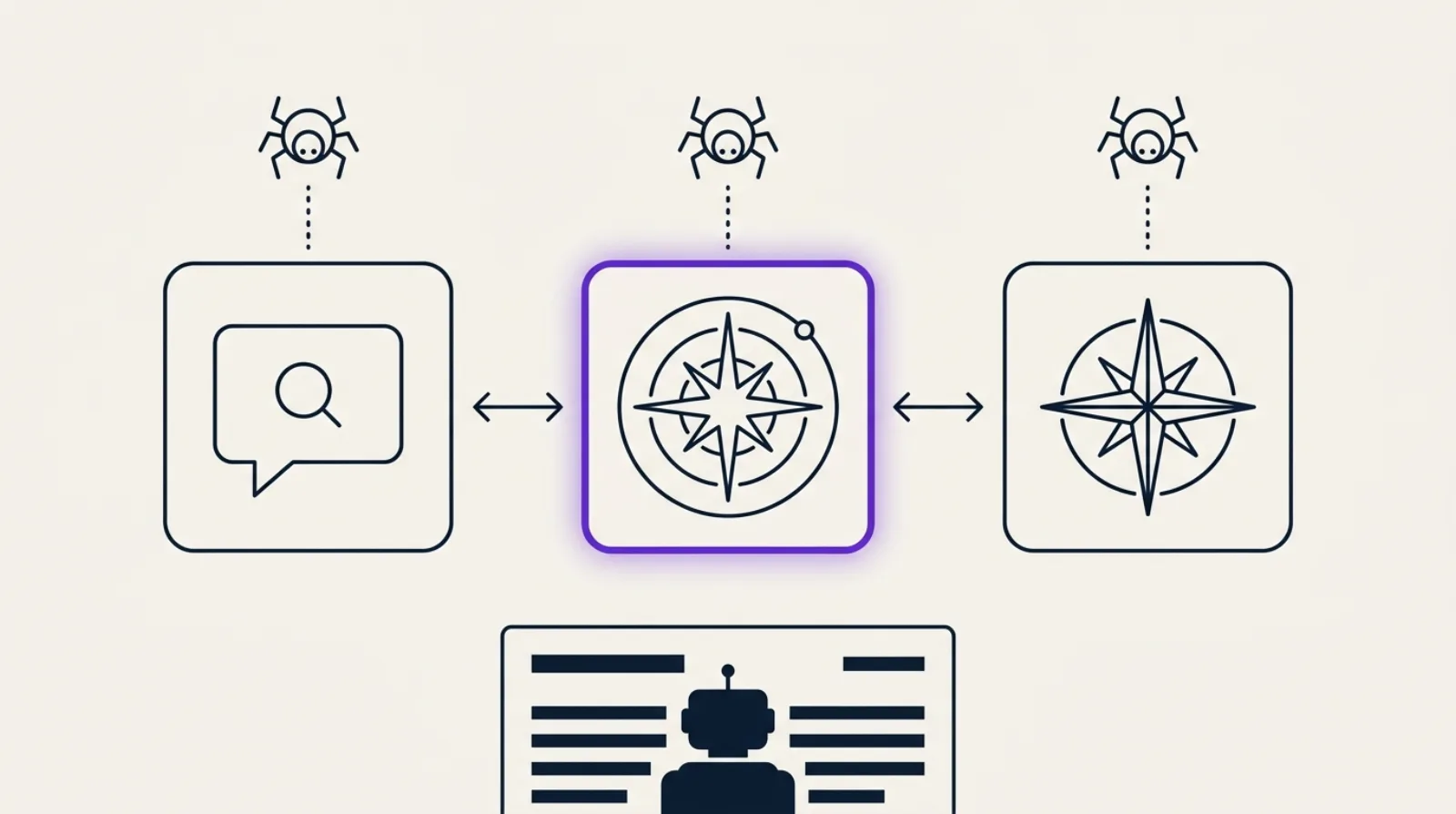
ChatGPT Search, Perplexity, and Bing Copilot: Three Pipelines, Three Distinct Strategies
Google AI Overviews gets all the SEO attention, but it's only one piece of the AI visibility puzzle. ChatGPT Search, Perplexity, and Bing Copilot collectively handle hundreds of millions of AI-powered queries every month. Each one cites sources. If your site isn't showing up in those citations, you're leaving qualified traffic behind.
The challenge: every AI engine runs its own crawler, maintains its own index, and weighs its own ranking signals. A strategy built for Google AIO won't transfer cleanly. Here's how each platform actually works, and how to target all three without tripling your workload.
ChatGPT Search (SearchGPT): How It Crawls and Cites
Bing Index as the Backbone, GPTBot as the Layer
ChatGPT Search doesn't build its index from scratch. For live queries, news, recent data, time-sensitive topics, it pulls directly from Bing's real-time index. But OpenAI also runs its own crawler, GPTBot (User-agent: GPTBot), which pre-indexes content for deeper semantic understanding, particularly for evergreen responses that don't require freshness.
This distinction matters in practice. Blocking GPTBot in your robots.txt doesn't remove you from ChatGPT Search entirely, Bing can still surface you, but you lose the semantic enrichment layer OpenAI builds from its own crawl. Don't block it.
What ChatGPT Search Prioritizes
- Structured data: Schema.org
Article,FAQPage,HowTo. ChatGPT is less strict than Google on markup syntax, but it uses schema to classify content type. - Author entity: A structured author page with
sameAslinks to LinkedIn, publications, or industry profiles increases the probability of being cited as an authoritative source. - Freshness signals:
datePublishedanddateModifiedin JSON-LD are actively read. A page untouched for 18+ months on a fast-moving topic gets deprioritized. - Concise factual paragraphs: ChatGPT rarely cites more than 3 sources per response. A tight, fact-dense paragraph outperforms a 2,000-word essay that buries the answer.
What ChatGPT Search Ignores
Paywalled content, PDFs without extractable text, and meta descriptions, none of these feed into ChatGPT Search's citation logic.
Perplexity AI: The Most Citation-Aggressive AI Engine
PerplexityBot: Fast, Systematic, Measurable
PerplexityBot (User-agent: PerplexityBot) is unusually aggressive with recrawl frequency, several sites have reported re-indexing within 48 hours of a content update. That's an opportunity: a freshly revised page can appear in Perplexity citations faster than on any other AI platform.
Perplexity also displays its sources as numbered inline citations ([1], [2]...) on every response. Every citation is clickable. Unlike AI Overviews or ChatGPT responses where referral traffic is murky, Perplexity citations generate direct, attributable sessions you can track in analytics.
What Perplexity Prioritizes
Factual density: Perplexity extracts specific fragments, statistics, definitions, comparisons, dates. A sentence like "average B2B SaaS freemium conversion rate sits at 2.3%" is far more citable than a generic paragraph on "the importance of conversion optimization."
Scannable structure: Perplexity reads pages like a time-pressed human. Clear H2/H3 headings, bullet lists, comparison tables, and definition callouts, anything that lets a bot (or person) extract a fact in under two seconds improves citation odds.
Core Web Vitals, especially LCP: PerplexityBot is notably sensitive to load speed. An LCP above 3 seconds is a negative signal. Aim for LCP < 2s on pages you want cited.
A Real Example
A French SaaS company in the invoicing space (~80,000 monthly organic visits) audited 12 key articles in March 2025: they added comparison tables, rewrote introductions using a "direct answer" format (question → answer in 1-2 sentences → elaboration), and reduced LCP from 4.1s to 1.8s. Measured at 60 days: +34 Perplexity citations on high-intent queries ("best invoicing software for SMBs", "online quote tool comparison"). Monthly Perplexity-referred sessions went from ~200 to ~1,100.
Bing Copilot: The AI Layer on the World's Second Search Engine
Bingbot, GPTBot, and How They Interact
Bing Copilot is embedded in Microsoft Edge, Bing.com, Windows 11, and Microsoft 365. Standard indexing runs through Bingbot (User-agent: Bingbot), the same crawler used for organic Bing results. But Copilot's response generation is powered by a licensed GPT-4 model from OpenAI, creating a hybrid architecture.
In practice: strong Bing indexing = Copilot citation potential. Block Bingbot, and you're invisible in both. GPTBot is a bonus signal for Copilot, not a prerequisite.
Why Bing Copilot Is Systematically Underestimated
Yes, Bing holds roughly 6% of the global search market. But Copilot reaches approximately 20% of AI assistant users in France (Microsoft France data, Q1 2026) through native Windows 11 integration, the Edge sidebar, and deep Microsoft 365 embedding. B2B SaaS marketers who dismiss Bing because of its search market share are missing a decision-maker audience that's already inside Microsoft's ecosystem.
Internationally, Copilot's footprint is even larger in enterprise-heavy markets (Germany, UK, US corporate).
Bing-Specific Optimization Signals
- Bing Webmaster Tools: Unlike Google Search Console, Bing lets you submit URLs directly and see which queries are triggering Copilot-style responses. If you don't have an account, it's a 20-minute setup.
- Schema.org: Bing reads the same schemas as Google, with stronger weighting on
Organization,Product, andFAQPagein Copilot response contexts. - Domain trust signals: Bing weighs domain-level authority signals more heavily than individual author signals, site age, backlinks from established institutional domains (.gov, .edu, major media).
Side-by-Side Comparison: The Three AI Engines
| Criteria | ChatGPT Search | Perplexity AI | Bing Copilot |
|---|---|---|---|
| Primary crawler | GPTBot + Bingbot | PerplexityBot | Bingbot |
| Index source | Bing + OpenAI index | Proprietary index | Bing index |
| User-agents to allow | GPTBot, OAI-SearchBot | PerplexityBot | Bingbot |
| Query types | General + news | Factual, comparisons | General + B2B productivity |
| Key signals | Schema, freshness, author entity | Factual density, LCP, structure | Domain trust, Schema, Bing WMT |
| Recrawl frequency | Moderate (GPTBot) / real-time (Bing) | High (< 48h possible) | Moderate |
| Citation format | Subtle inline, 2–4 sources max | Numbered inline, systematic | Inline within Copilot response |
| Share of AI queries (2026) | ~15% | ~10% | ~20% of AI users (France) |
6 Priority Actions to Get Visible Across All Three
These actions have cross-platform impact, they improve your visibility on ChatGPT Search, Perplexity, and Bing Copilot simultaneously, and they carry over to Google AIO as well.
1. Audit your robots.txt right now
Make sure none of these User-Agents are blocked: GPTBot, OAI-SearchBot, PerplexityBot, Bingbot, CCBot. CCBot feeds Common Crawl, which is used in foundational model training, blocking it doesn't remove you from real-time responses, but it reduces your footprint in underlying model knowledge.
2. Open every key article with a direct answer
Frame the target query as an H2 question. Answer it in 1-2 sentences immediately after. Then develop. This structure is readable by every AI crawler and maximizes extraction probability.
3. Embed verifiable data in every strategic section
You don't need proprietary research. Cite public sources (government data, industry reports, official statistics) with the URL inline. AI engines prioritize fragments that can be verified.
4. Deploy FAQPage schema on your highest-value pages
FAQPage delivers the best cross-platform ROI of any schema type. It's read by Google, ChatGPT, Bing Copilot, and partially by Perplexity. Three questions per page, answers under 50 words each.
5. Hit LCP < 2s on your citation-target pages
Perplexity is the most sensitive to this signal, but fast load times improve crawl experience for GPTBot and Bingbot too. A slow page is a signal of low quality across every AI platform.
6. Set up Bing Webmaster Tools
Submit your sitemap, check indexation, identify blocked URLs. It's the fastest lever to improve Bing Copilot presence, results visible within a week of setup.
Run Your GEO Audit
Want to know exactly where you stand across these three AI engines? SeAudit's GEO audit analyzes your citation potential on ChatGPT Search, Perplexity, Bing Copilot, and Google AIO, and gives you a prioritized action plan based on your actual site, not a generic checklist.
Or check out our service plans if you'd rather have us handle it.
Key Takeaways
- ChatGPT Search uses Bing for live indexing and GPTBot for semantic depth. Don't block either crawler.
- Perplexity indexes fast, cites systematically, and rewards factual density and load speed above all else.
- Bing Copilot reaches ~20% of AI assistant users in major markets through Windows/Edge/M365, don't write it off because Bing has 6% search market share.
- All three platforms converge on the same fundamentals: clear structure, verifiable data, Schema.org markup, and an open
robots.txt. - One action you can do right now: check that
GPTBot,PerplexityBot, andBingbotaren't blocked in yourrobots.txt. Three minutes. Potentially significant impact.
Related: What Is GEO?, Google AI Overviews: How to Get Cited
slug-fr: chatgpt-search-perplexity-bing-copilot-visibilite-moteurs-ia
slug-en: chatgpt-search-perplexity-bing-copilot-ai-engine-visibility
excerpt-fr: ChatGPT Search, Perplexity et Bing Copilot ont chacun leur propre crawler, leur propre index et leurs propres signaux de citation, une stratégie Google AIO ne suffit pas. Voici comment décrypter les 3 pipelines et être visible sur tous en même temps.
excerpt-en: ChatGPT Search, Perplexity, and Bing Copilot each run their own crawler, index, and citation logic, your Google AIO strategy won't transfer directly. Here's how to decode all three pipelines and get cited across every major AI engine.
coverAlt-fr: Schéma comparatif des trois moteurs IA, ChatGPT Search, Perplexity et Bing Copilot, avec leurs crawlers et signaux de citation respectifs
coverAlt-en: Comparative diagram of three AI search engines, ChatGPT Search, Perplexity, and Bing Copilot, showing their respective crawlers and citation signalsagentId: ad7be4e84e66bbe2a (use SendMessage with to: 'ad7be4e84e66bbe2a' to continue this agent) <usage>total_tokens: 22344 tool_uses: 0 duration_ms: 118693</usage>