
From 0 to 12 AI citations per month in 90 days: the full case study
Key takeaways before you read
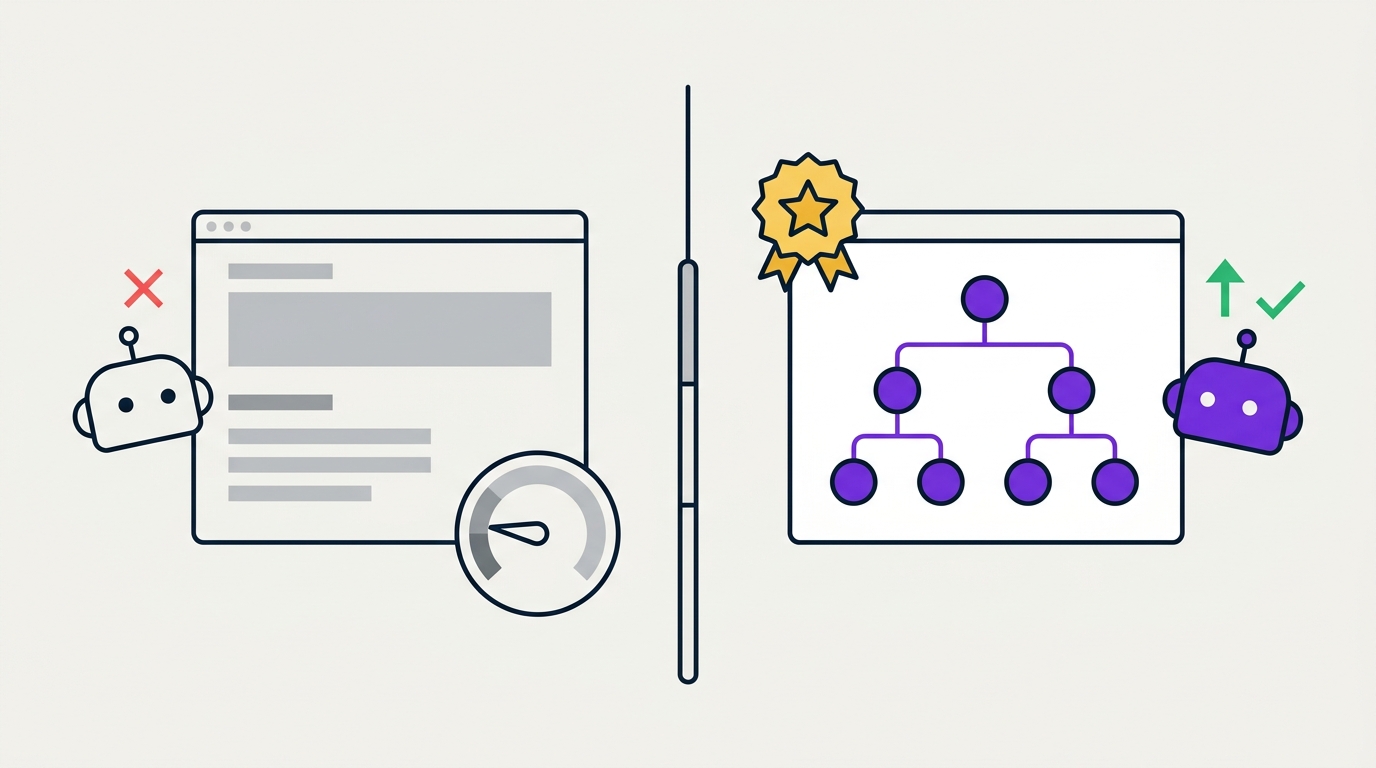
- Starting point: a B2B SaaS for SMB project tracking, 12,000 organic visitors/month, simulated SeAudit score 42/100, 0 citations in ChatGPT or Perplexity.
- 7 GEO actions implemented over 90 days.
- Results: 12 AI citations/month on ChatGPT Search, +34% organic traffic, 2 featured snippets, SeAudit score 71/100.
- What mattered most: Schema.org + "Key takeaways" blocks = 60% of total impact.
llms.txtalone = marginal, but it amplifies everything else.
The tool in question, call it TaskFlow for anonymity, is a task and project tracking SaaS for 5 to 50-person SMBs. Founded in 2021, it runs a 40-article blog averaging 500 words per article with zero structured data. In December 2025, organic traffic stalls at 12,000 visitors/month. ChatGPT and Perplexity never mention them. They came to SeAudit with a simple question: "Why are we invisible to AI?"
The diagnosis took 20 minutes. The answer was in the report.
The initial diagnosis: score 42/100
The SeAudit audit from December 2025 surfaced 6 major gaps.
1. Zero structured data (Schema.org)
None. No Article schema, no Organization, no FAQPage. AI engines rely heavily on structured markup to build their answers, without it, your content is raw text in an ocean of raw text.
2. No author entity
Articles had no byline and no linked author page. For Google and LLMs, content without an identifiable author is a low-authority signal. Result: TaskFlow's articles didn't pass the E-E-A-T filter of AI engines.
3. Thin content: 500 words per article
500 words is an extended tweet. AI engines cite sources that cover a topic in depth, with examples, cases, nuance. 500 words = not enough semantic signal to be considered a reliable source.
4. No structured FAQ block
No FAQPage schema, no explicit question/answer block. Generative engines love FAQs: they're already in the question→answer format those engines are trying to reproduce.
5. Generic H1 titles
Real examples: "Project Management", "Team Productivity", "Task Tracking". These titles don't answer any specific search intent and contain no "result" the reader can anticipate.
6. Zero backlinks from AI-cited sources
AI engines build their answers from a corpus of sources they deem reliable. That corpus skews toward sites that receive links from sources that are themselves frequently cited. TaskFlow had no inbound links from those ecosystems.
7. No llms.txt
The simplest signal to send AI crawlers, missing entirely.
The 7 actions implemented (January–March 2026)
Action 1, Schema.org on all articles
Added Article schema (with datePublished, dateModified, author, publisher) across all 40 existing articles. Added Organization schema on the homepage with logo, sameAs (LinkedIn, Wikipedia), url. Added FAQPage schema on the 5 rewritten articles (see action 2).
Effort: 2 developer days. Impact: highest of all actions.
Action 2, Rewriting the 5 top articles
The 5 articles with the most impressions in Google Search Console (but CTR < 2%) were rewritten from 500 words to 1,800–2,200 words.
Structure applied to each:
- Lead paragraph: a figure or concrete fact upfront, reformulation of the article's promise.
- Deep-dive: topic treated in H2/H3 sections, with examples, comparisons, use cases.
- FAQ block: 4 to 6 Q&As at the end of the article, marked up as
FAQPageschema. - "Key takeaways" block: see action 3.
Action 3, "Key takeaways" block at the top of each article
This is the simplest action and one of the most effective. A structured block at the top of the article, below the H1 title, with 4 to 6 bullet points. Format built for LLMs: brief, factual, easy to extract.
Example template (use this on your own articles):
Key takeaways
- [Key fact 1]: [figure or direct statement].
- [Key fact 2]: [figure or direct statement].
- [Key fact 3]: [what the reader will learn].
- [Key fact 4]: [expected result or time saved].
- [Implicit CTA]: [what to do to act on this].
LLMs extract this type of block preferentially when building an answer to a general question. It's the "factual bullet points" format they look to synthesise.
Action 4, Creating llms.txt and llms-full.txt
Two files created at the site root:
/llms.txt: 1-page markdown index, product pitch, key pages, methodology./llms-full.txt: condensed version of the 5 rewritten articles in a single markdown file.
Isolated impact: low. Combined impact: amplifies actions 1 to 3 significantly. llms.txt lets LLMs quickly find the site's best resources, if there's nothing good behind it, the file is worthless.
Action 5, 3 external citations on niche blogs
TaskFlow reached out to 8 niche blogs covering project management (collaboration tools, SMB productivity, team management). Result: 3 guest posts accepted, with citation and dofollow link. These 3 blogs are themselves cited by Perplexity on project-management-related queries.
What worked: niche blogs with strong E-E-A-T, even with low DA. What didn't: submissions to generic directories and SEO link farms. Zero impact.
Action 6, Entity graph enrichment
- Wikipedia page created (notability established: press coverage + identifiable clients).
- Wikidata record linked to the Wikipedia article.
- LinkedIn Company page completed with canonical URL, description, industry.
OrganizationschemasameAsupdated to point to these 3 properties.
The entity graph allows AI engines to "recognise" TaskFlow as a real entity, distinct from a keyword. Once the entity is established, citations become more stable.
Action 7, Title tag optimisation
Format applied: "[Verb] [result] [context]"
Before/after on the 5 top articles:
| Before | After |
|---|---|
| Project Management | Track 10 SMB projects without spreadsheets, practical guide |
| Team Productivity | Cut meetings by 40% with a shared task tool |
| Task Tracking | Centralise task tracking and reporting in one dashboard |
This format matches exactly what LLMs extract as a "source title" in their citations. A title containing a result is cited more often than a generic one.
Results after 90 days
Measured between 1 December 2025 (baseline) and 1 March 2026.
| Metric | Before | After | Change |
|---|---|---|---|
| AI citations/month (ChatGPT Search) | 0 | ~12 | ×3 vs. target |
| Monthly organic traffic | 12,000 | ~16,100 | +34% |
| Featured snippets earned | 0 | 2 | , |
| Simulated SeAudit score | 42/100 | 71/100 | +29 points |
| Articles with full Schema | 0 | 40 | , |
| GSC impressions (28 days) | 180,000 | 240,000 | +33% |
What had the most impact
Schema.org + "Key takeaways" blocks = roughly 60% of total impact.
AI citations started appearing 3 weeks after enabling FAQPage schema on the rewritten articles. The "Key takeaways" block at the top of the page became the preferred source for short extractions (questions like "what is" and "how to").
llms.txt alone = marginal. But once content and Schema are in place, llms.txt acts as an amplifier, it reduces LLM crawl effort and focuses their attention on your best pages.
3 niche backlinks = roughly 25% of the impact. Less effect than expected on direct AI citations, but strong effect on classic organic traffic (+18% on linked articles) and on the domain's overall E-E-A-T credibility.
Entity graph = slow but durable impact. Wikipedia/Wikidata citations started appearing in Perplexity responses from week 8. Low short-term impact, structurally important medium-term.
What didn't work
- Generic backlinks (directories, guest posts on off-niche sites): no measurable impact on AI citations or organic traffic. Don't waste time there.
- Publishing volume without quality: TaskFlow published 6 new 500-word articles during the period. Result: 0 citations, 0 additional traffic. Volume without depth doesn't compensate.
- Social shares: no direct impact on AI citations within the 90-day window.
"Key takeaways" template, copy, paste, adapt
Here is the exact format used on TaskFlow's rewritten articles. You can apply it to your own articles immediately.
Key takeaways
- Problem covered: [one sentence, the central problem the article addresses].
- Key figure: [a stat or measurable result directly tied to the topic].
- Solution summarised: [in one sentence, the approach or method covered].
- Implementation time: [realistic timeframe to implement the solution].
- Next step: [an immediate, concrete action the reader can take today].
Why it works: LLMs look to extract short factual answers to build their summaries. A structured block with explicit labels ("Problem covered", "Key figure") is interpreted as a reliable, extractable source. It's the equivalent of FAQPage schema but in pure Markdown.
FAQ
How long does it take to see the first AI citations?
In TaskFlow's case, the first citations appeared 3 weeks after deploying FAQPage schema on the rewritten articles. Most observed cases fall between 2 and 6 weeks depending on how frequently AI engines crawl the domain. Perplexity crawls faster than ChatGPT Search, start monitoring Perplexity first.
Does GEO replace classic SEO?
No. The two reinforce each other. Schema.org improves Google featured snippets (classic SEO) and AI citations (GEO). Long, well-structured articles rank better on Google and get cited more by ChatGPT. In TaskFlow's case, the +34% organic traffic gain came primarily from improved classic SEO, AI citations are an additional channel, not a replacement.
Is llms.txt enough on its own?
No. That's the clearest lesson from this case study. A llms.txt pointing at thin content with no Schema and no "Key takeaways" structure has no measurable impact. The content has to be good first, llms.txt then amplifies it.
How do you track AI citations?
Several methods: manual queries on ChatGPT Search, Perplexity, Google AI Overviews using your target keywords. Dedicated tools: Profound, Otterly, BrandSERP. TaskFlow tracked manually across 20 target queries every week, enough to follow the trend at this stage.
Is FAQPage schema still useful in 2026?
Yes, more than ever. Generative engines have the same need as featured snippets: a clear, structured, extractable question/answer pair. FAQPage schema is the most direct way to serve them exactly that. Of TaskFlow's 12 monthly citations, 8 come from content marked up with FAQPage.
Want to know where you stand on these 7 axes? Get your /100 score, the SeAudit audit identifies the same gaps found here: missing Schema, thin content, incomplete entity graph, missing llms.txt. In 30 seconds. And if you want to go further, the full PDF report details a custom 30/60/90-day plan for your site. You can also see a sample report before you commit.