
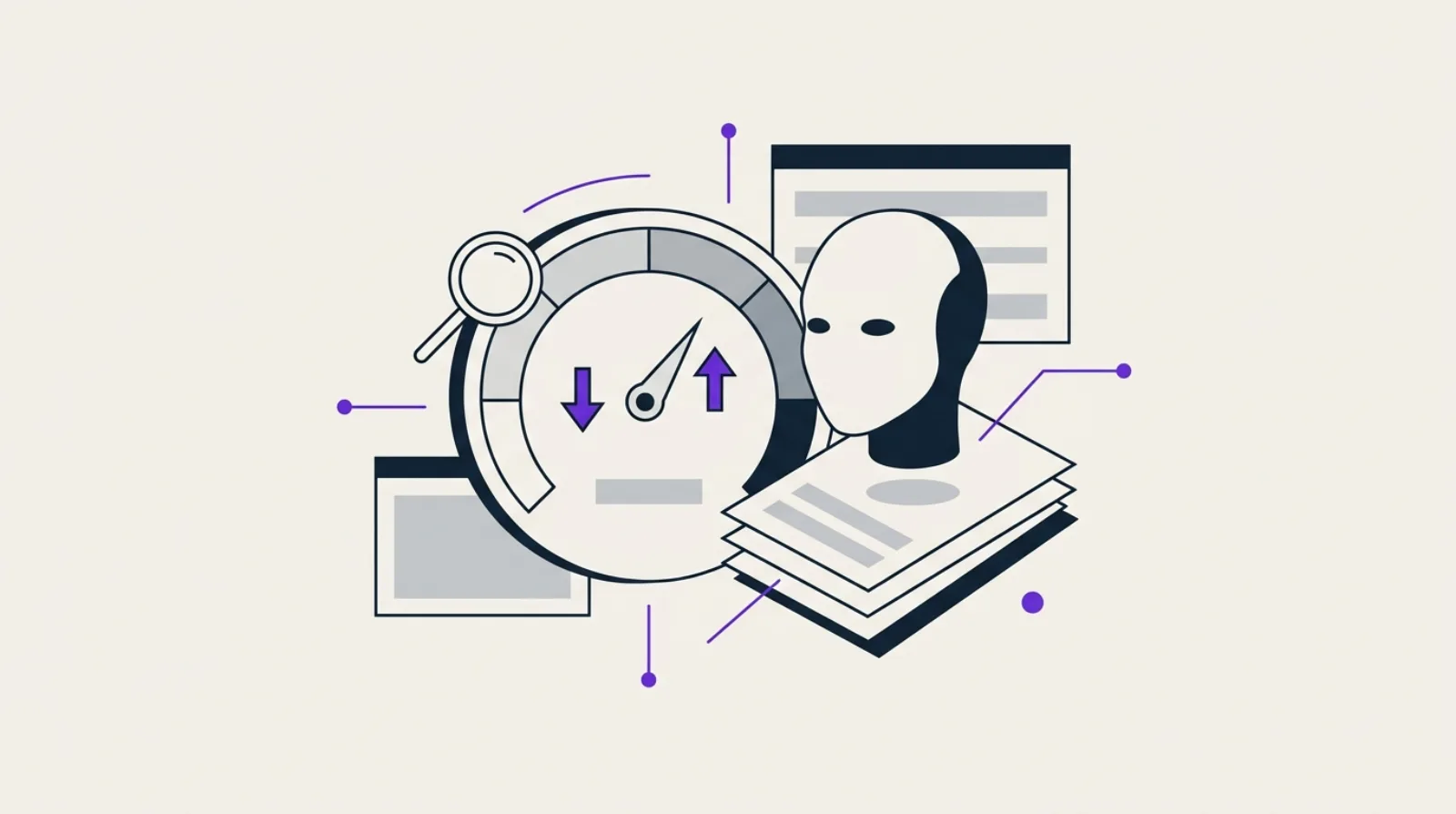
Your Google traffic dropped 20% in a week, and you have no idea whether it's a penalty, a technical bug, or simply the latest Google core update reshuffling the rankings. Since the May 2026 core update, this is the question that comes up in almost every audit we run on SeAudit: "what do I actually do about this, right now?"
The bad news: there's no 48-hour fix. The good news: there is a method, and it starts with a diagnosis most SEO guides skip entirely, figuring out whether you actually lost ranking, or whether your clicks got absorbed by AI-generated answers (AI Overviews, generative AI) answering the query before the user even clicks through.
What a Google core update actually is in 2026
A core update is a broad update to Google's ranking algorithm, rolled out over days to weeks, affecting every industry and language at once. Unlike a targeted update (spam, links, helpful content), a core update deeply recalibrates how Google evaluates relevance and quality, without announcing exactly which signals changed.
What's different in 2026: Google is increasingly aligning its classic organic ranking with the criteria that determine citability inside generative answers (AI Overviews first and foremost). A page losing organic positions often also struggles to get picked up in an AI summary, both problems share the same root: content perceived as poorly structured, poorly sourced, or redundant with what already exists elsewhere.
During the rollout: rule number one
As long as the rollout isn't officially over (Google communicates an end date), don't touch anything structural: no navigation overhaul, no mass page deletion, no rewriting every title tag in one go. Fluctuations during rollout are normal and don't yet reflect the final ranking state, changing your site mid-instability makes it impossible to know what actually mattered.
The only safe actions during this window: collect your data (export your rankings and traffic for the 28 days before the update started), and document, without executing, your action plan for afterward.
The real diagnosis: lost ranking, or absorbed by AI?
This is the step most classic SEO checklists skip entirely, and it's where thinking SEO + GEO changes everything. A drop in clicks inside Search Console can have two very different causes, calling for opposite responses:
- Actual ranking loss: your average position dropped on key queries. The problem is competitive or qualitative, other pages are now judged more relevant than yours.
- AI absorption: your position barely moved, but your impressions convert into fewer clicks because an AI Overview or a generated answer now answers the query directly, above your result.
| Search Console signal | Ranking actually lost | Absorbed by AI |
|---|---|---|
| Average position | Clearly down | Stable or near-stable |
| Impressions | Often stable or down | Stable, sometimes up |
| CTR | Moderate drop | Sharp drop, even at position 1-3 |
| Affected queries | Varied, specific keywords | Concentrated on broad informational queries |
The first case gets fixed with classic levers (content, authority, technical). The second requires reworking your content so it gets cited inside the generated answer instead of competing for a position below it, Q&A structure, clean data points, directly extractable phrasing.
The post-update checklist, step by step
Once the rollout is over, wait at least a full week before drawing firm conclusions, Google recommends letting rankings settle first. Then work through this order:
- Compare two equivalent periods in Search Console (28 days before vs. 28 days after the rollout ended), filtered by page and query, not just the aggregate view.
- Identify winning and losing pages. Sort by click change, not just position, a page can lose clicks without losing position (AI absorption), and vice versa.
- Check for cannibalization. Two pages competing for the same query weaken each other, a flaw core updates tend to punish more harshly. Our keyword cannibalization guide covers how to spot and fix it.
- Audit your E-E-A-T signals on the losing pages: identified author, visible update date, cited sources, demonstrated real-world experience. Our E-E-A-T guide lists the signals that actually matter.
- Assess real content quality, not just length: does a losing page fully answer the search intent, or does it stay surface-level?
- Check internal linking to affected pages, isolated content, with no inbound links from authoritative pages on your site, loses legitimacy in Google's eyes.
- Measure your visibility in AI answers on the same queries, not just your Google ranking, the two increasingly move independently of each other.
A concrete example: two profiles, two different diagnoses
In a typical audit run after the May 2026 core update, two comparably sized e-commerce sites showed similar symptoms (organic traffic decline) but opposite root causes:
| Metric | Site A (ranking loss) | Site B (AI absorption) |
|---|---|---|
| Organic traffic | -24% | -17% |
| Average position | 8.4 → 14.1 | 6.2 → 6.5 |
| Impressions | -9% | +6% |
| Average CTR | 3.1% → 2.4% | 4.8% → 2.9% |
| Dominant cause | Cannibalization between 2 categories + stale content | Informational queries absorbed by AI Overviews |
Site A fixed its cannibalization issue and refreshed its category pages: a gradual recovery over 7 weeks. Site B had nothing to fix on the ranking side, the work focused on restructuring content into directly citable blocks, to become a visible source inside the AI summaries rather than a link below them.
How long before you see an effect?
Be honest with yourself about timelines: a substantial content or authority improvement generally takes 4 to 8 weeks to show up in rankings, and a full recovery after a heavy hit can take 2 to 3 months, sometimes until the next core update. There's no "instant re-evaluation" mechanism, Google re-crawls and re-evaluates continuously, but the scale of a content fix takes time to be fully factored in.
Key takeaways
- Don't touch anything structural during a core update rollout, wait for the official end, then one more week
- Always distinguish actual ranking loss (position down) from AI absorption (position stable, CTR collapsing): the fixes are different
- Cannibalization, E-E-A-T, content quality, and internal linking remain the four most reliable levers after a core update
- Expect 4 to 8 weeks for a first effect, 2 to 3 months for a full recovery
- Google ranking and AI-answer visibility now need two separate diagnoses, even though they often share the same root cause
FAQ
Should I panic if my traffic drops during a core update?
No. Fluctuations during rollout are normal and don't reflect the final ranking. Collect your data, don't change anything structural, and wait for the official rollout end plus one week before analyzing anything seriously.
How do I know if I lost ranking or if AI is absorbing my clicks?
Compare your average position before/after: if it dropped noticeably, that's a classic ranking problem. If it's stable but your CTR is collapsing on informational queries, it's likely AI absorption from an AI Overview or generated answer, two diagnoses that call for different fixes.
Can a core update penalize a site for no apparent reason?
Rarely "for no reason": a drop usually surfaces a problem that was already there (cannibalization, stale content, weak perceived authority) that the new algorithm now detects better than before. Treat it as a reason to dig in, not just wait it out.
How long does it take to recover from a core update?
Generally 4 to 8 weeks for a first measurable effect after serious fixes, and up to 2-3 months for a full recovery on the hardest-hit cases. Some sites only fully recover at the next core update.
Want to know whether your traffic drop is a ranking problem, AI absorption, or both? Get your free /100 score in a few minutes and identify priorities, or grab the full PDF report for a page-by-page action plan.