
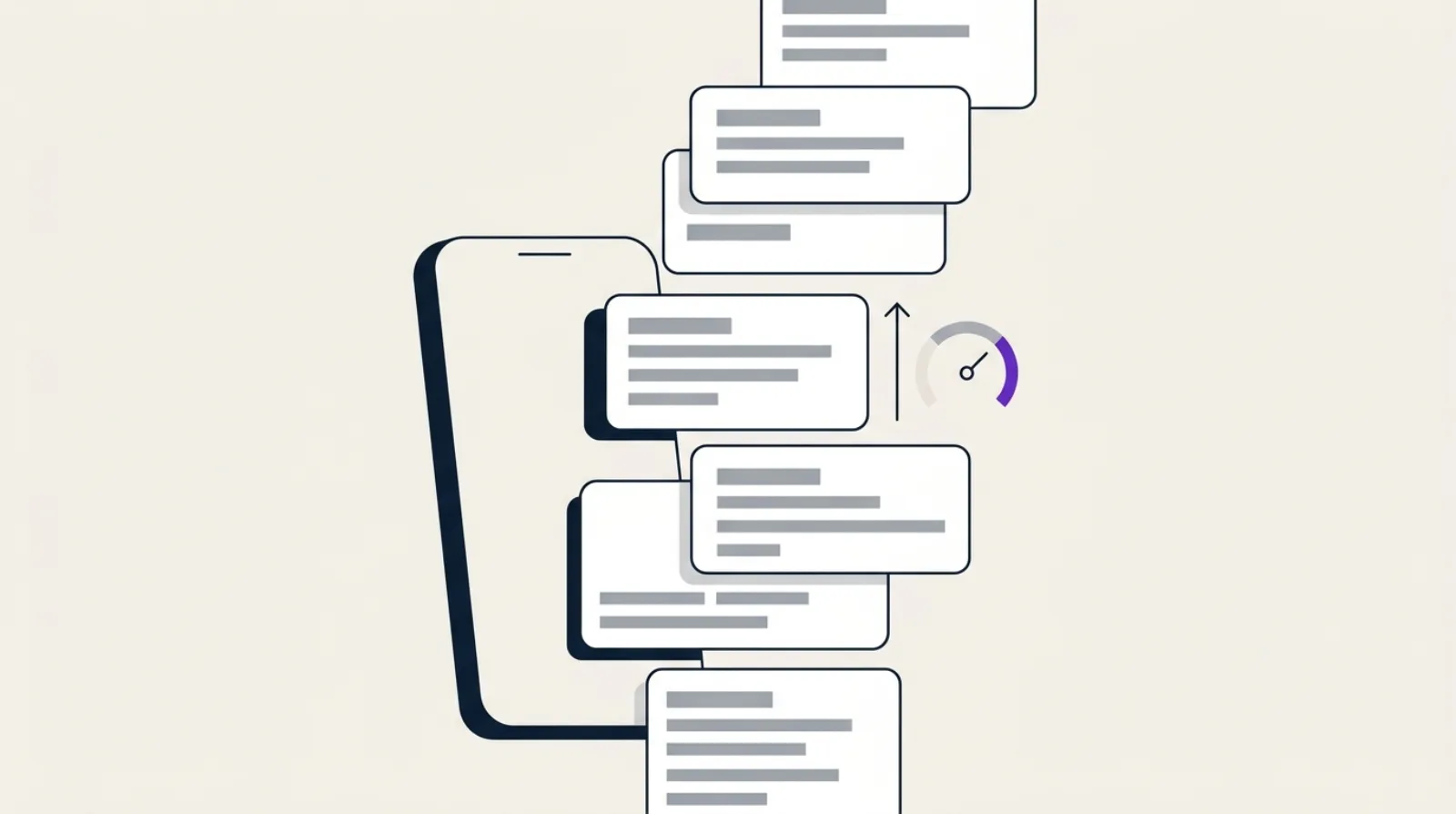
You're optimizing your classic SEO, you're starting to work on your citability in AI-generated answers, and you're completely ignoring a third channel that often sends more clicks than the other two combined on mobile Android: Google Discover. It's neither classic SEO (no query typed by the user) nor GEO in the strict sense (no AI generating and citing an answer): it's a personalized algorithmic feed, powered by Google's machine learning, that pushes content to users who searched for nothing at all. And the February 2026 Discover update changed part of the rules.
What Google Discover actually is
Google Discover is the personalized content feed that appears in the Google app and on the mobile Chrome homepage, without any query being typed. Google pushes articles based on a user's inferred interests, not on a searched keyword. That's what makes it a third pillar of visibility, distinct from Search (the user searches) and GEO (a generative AI answers and cites sources): here, Google guesses what a user might want to read before they know it themselves.
This channel isn't a footnote: on many editorial sites, Discover sends roughly twice as many clicks as classic search, largely through the Google app on Android. For content that qualifies, that's a traffic spike that can dwarf what organic SEO brings to the same page.
What changed with the February 2026 update
On February 5, 2026, Google rolled out a dedicated Discover update that strengthens three criteria: local relevance, a reduction of clickbait, and a clearer reward for genuine expertise (E-E-A-T signals). In practice, sensational or purely summarized content (aggregation with no added value) gets pushed down in favor of original content with an identifiable point of view.
This is consistent with Google's broader trajectory across classic search and generative answers: the three channels, Search, Discover, AI Overviews, increasingly converge on the same underlying signals (originality, demonstrable expertise, clear structure), even though the display mechanics remain different.
The technical checklist to qualify
Three families of technical prerequisites condition your presence in Discover, and they're checkable in a few minutes:
- Images: at least 1200 pixels wide, with the meta tag name="robots" content="max-image-preview:large" in the page head. Without this tag, Google technically can't display your thumbnail at full size in the feed, and posts with a large image measure roughly 45% higher CTR than those with a small or missing image.
- Structured data: Article or NewsArticle markup in Schema.org, with author markup including credibility signals (author schema). It's not strictly mandatory to appear in Discover, but it strengthens machine readability of who wrote what, and with what legitimacy.
- Core Web Vitals: commonly recommended thresholds are LCP under 2.5 seconds, INP under 200 milliseconds, and CLS under 0.1. A slow or visually unstable site isn't necessarily excluded from Discover, but it lowers the odds of being pushed there consistently.
Freshness and cadence: the real key to durability
Discover heavily favors freshness: most of a post's Discover traffic arrives within 48 to 72 hours of publishing, then drops off fast. That's very different from classic SEO, where a well-ranked page can capture stable traffic for months or years without being touched.
To extend your Discover presence beyond the initial spike, regularly updating content matters more than simply publishing something new. In practice, refresh high-Discover-potential pages based on their volatility: high-news-value topics every 2 to 4 weeks, medium-evolution topics every 6 to 8 weeks, evergreen topics roughly every 12 weeks. A page updated with new data or a new angle can trigger a fresh evaluation from Discover's algorithm, while a static page fades after its initial spike.
Discover, Search, AI Overviews: three feeds, three logics
| Criterion | Search (classic SEO) | Discover | AI Overviews / generative answers (GEO) |
|---|---|---|---|
| Trigger | Query typed by the user | No query, feed pushed based on inferred interests | Query typed, answer synthesized by AI |
| Traffic window | Can last months/years | 48-72h spike, then fast decay | Variable, depends on citation in the answer |
| What matters most | Relevance + authority + technical health | Freshness + image + originality + E-E-A-T | Extractable structure + sourced numbers + clarity |
| Measured in Search Console | Search performance report | Dedicated Discover report (if volume is sufficient) | No dedicated report, inferred from impressions/CTR |
How to measure your Discover performance
Google Search Console offers a dedicated Discover performance report, but it only activates once your site has generated a meaningful volume of Discover impressions, a new or low-traffic site may see nothing there at all, which doesn't necessarily signal a problem. When the report is available, track three metrics: weekly Discover impressions (raw visibility), CTR per post (quality of the image + headline pairing), and spike duration per article (perceived freshness). A sitewide drop in Discover impressions with no editorial change on your end often coincides with an algorithm rollout rather than a specific issue you need to fix urgently.
The most common mistakes
Publishing sensational content just to catch a Discover spike with no real substance is the first mistake: the February 2026 update specifically deprioritizes that kind of content, and a spike with no substance builds no lasting authority. The second mistake is neglecting the image: a generic or too-small visual kills a large share of the click potential, even when the content itself is excellent. The third is treating Discover as a separate channel that needs no underlying structure, when the same fundamentals that serve your citability in AI answers (clarity, numbers, structure) also benefit your presence in Discover.
FAQ
Is Google Discover a classic SEO ranking factor?
No. Discover is a channel distinct from search rankings: your position in classic search results and your presence in Discover can move independently of each other, even though both share common quality signals (E-E-A-T, structure, originality).
Can a B2B or niche site appear in Discover?
Yes, but with mechanically lower volume than a mass-audience site: Discover runs on personalized interests, and a B2B site reaches a narrower audience. It's not a channel to ignore, but don't expect the same volumes as a general-interest publisher.
Why does my Discover traffic collapse after two or three days?
That's Discover's normal behavior: the feed favors freshness, and a post that's no longer "new" naturally loses its place in users' personalized feeds, replaced by more recent content. A substantial content update can trigger a new visibility window.
Do I need specific structured data for Discover?
It's not strictly mandatory, but Article or NewsArticle markup with author information strengthens the machine readability of your content and makes it easier to assess its E-E-A-T, a signal that matters increasingly since the February 2026 update.
If you want to know where your visibility is losing the most ground, classic search, Discover, or AI citations, get your free score out of 100, or check out a sample full report to see the level of detail provided. To go deeper on the fundamentals that serve both your AI citability and your Discover presence, our full PDF report breaks down every E-E-A-T signal worth working on.