
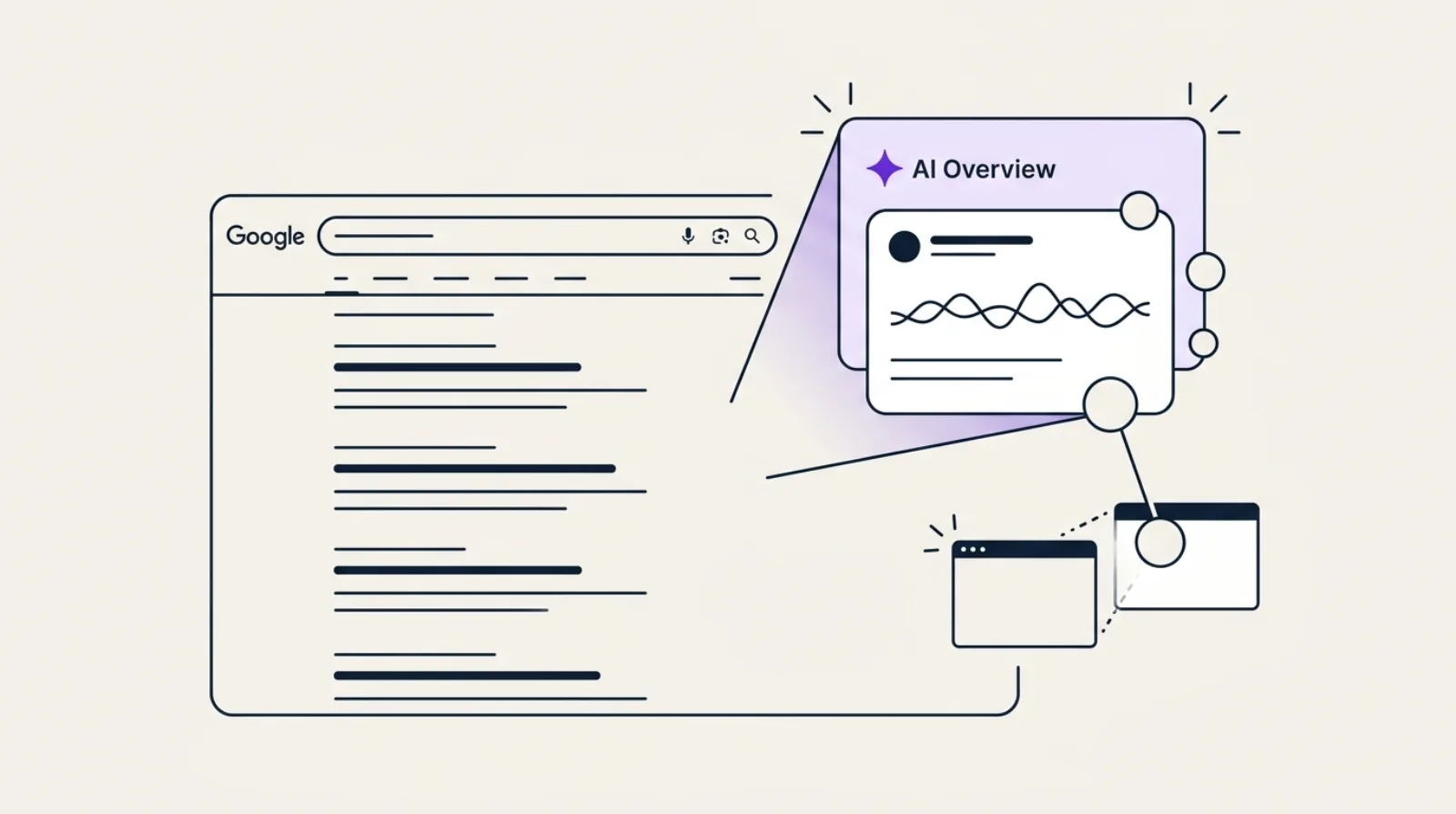
Google AI Overviews: Who Gets Cited, Who Gets Ignored
You know the blue/purple box that pops up at the very top of Google before the organic results. For 30 % of informational queries in France in Q1 2026 (BrightEdge), Google generates this AI Overview with a handful of cited sources below. If your site is among them: traffic, authority, brand visibility. If it's not: your article can be ranked #1 organically and still see average CTR drop by 35 to 60 %.
Spoiler: getting cited in an AI Overview has very little to do with ranking organically. This article walks through how AI Overviews actually pick their sources, and gives you 10 concrete actions to enter the candidate set.
How Google AI Overviews Picks Its Sources
Based on Ahrefs, Surfer and SE Ranking studies from the first halves of 2025-2026, the mechanism breaks down into 3 steps:
Step 1, Candidate Set Retrieval
Google runs a classic search on the query and keeps the top 30 to 50 organic results. That's the regular SEO layer. If you're not in the top 30 for the query, you don't get into the rest of the pipeline.
Direct consequence: all your classic SEO still matters. No domain authority, no fresh content, no backlinks → you're not even in the race.
Step 2, Re-ranking by Gemini on Citability
Gemini, which powers AI Overviews, reads the candidates and picks the ones it will cite. The criteria observed in 2026:
- Passage citability: ability to extract a short paragraph that precisely answers the question, with no external context.
- Factual consistency: precise verifiable numbers, explicit dates, institutional sources cited.
- Semantic structure: clear H2/H3, FAQ Schema, ordered lists, comparison tables.
- Freshness: for time-sensitive topics (numbers, regulation, prices), a recent updatedAt counts a lot.
- Source diversity: Google avoids citing 3 articles from the same site. If your competitor is already cited, your page jumps ahead at equal authority.
Step 3, Final Selection (2-5 sources)
The AI Overview generally shows 2 to 5 clickable source chips. Domains dominating in 2026: institutional sites (.gov, .europa.eu, ADEME), established media, company blogs with strong editorial authority. Personal blogs and new sites are nearly absent, except in niche-specific cases with little competition.
The Backlink Myth for AI Overviews
You might have read that to enter AI Overviews you need high-quality backlinks. That's false in half the cases.
2026 AI Overviews studies show:
- 40 % of cited sources are pages that weren't in the top 3 organic results before AIO.
- 25 % of cited sources come from sites with Domain Rating < 40 (so relatively few backlinks).
- The most correlated factor, beyond domain authority, is the density of short and precise citable passages.
Conclusion: new sites can break into AI Overviews without massive backlinks if they deliver structured and factually precise content. That's a real window of opportunity against lazy big sites.
10 Concrete Actions to Get Cited in Google AI Overviews
Here are the levers to pull, from highest leverage to most marginal.
1. Structure Your H2s as Exact Questions
The AI Overview answers a question. If your H2s are textual questions close to what people type, Gemini extracts the answer below them more easily.
Bad: ## Panel performance
Good: ## How many kWh does a 400W solar panel produce per year in France?
2. Write Short, Factual Lead Paragraphs
After each H2 question, open with a 2-3 sentence paragraph that directly answers, with a precise number if possible. That's the paragraph Gemini will cite.
Bad: "Panel performance depends on many factors…" Good: "A 400 Wc panel produces on average 480 to 560 kWh per year in mainland France. Output varies by region: 600 kWh in the south, 420 kWh in the north."
3. Implement FAQ Schema JSON-LD on Your Key Articles
FAQ Schema gives Gemini a pre-chewed question/answer structure. Pages with properly implemented FAQ Schema are 2.3x more likely to be cited in AI Overviews per 2026 benchmarks.
Minimal example:
```html
<script type="application/ld+json"> { "@context": "https://schema.org", "@type": "FAQPage", "mainEntity": [{ "@type": "Question", "name": "Your exact question", "acceptedAnswer": { "@type": "Answer", "text": "Your short factual answer." } }] } </script>```
4. Add Organization and Person Schema
On your homepage and About page, declare Organization. On your articles, declare the author as Person with their credentials. These are E-E-A-T signals Gemini reads.
5. Update Both Publication AND Modification Dates
The datePublished AND dateModified should be visible to users AND in the Article Schema. For time-sensitive topics, a dateModified less than 6 months old increases citation rate by 40 %.
Keep a systematic update calendar for your top-traffic articles.
6. Cite Institutional Sources in Your Content
Pages that cite official organizations, government sites, academic sources via hyperlinks are weighted better by Gemini on factual consistency. It's not flattery: it's a traceability signal.
7. Avoid Dilution in Long Content
A 4,000-word article covering 10 different questions has less chance of being cited than a 1,200-word article that precisely answers 1 question. Gemini favors specialized pages.
Practical consequence: break your monster guides into several short, specific articles.
8. Add Precise Numbers Everywhere Possible
"Many" → 47 %. "Often" → 3 times out of 4. "Several hours" → 4 to 6 hours. "Significant" → +25 % on average.
The more your claims are quantified and sourceable, the more Gemini extracts them with confidence.
9. Optimize for Question-Modifiers
Queries that trigger an AI Overview are mostly those with modifiers: "how", "why", "what is", "how many", "which", "is it". Target these formulations in your H2s and titles.
10. Track Where You're Cited (and Where You Could Be)
Use SeAudit to scan your key pages and identify concrete GEO opportunities. For more on AI search, also see our guide What is GEO?.
The Trap to Avoid: Over-Optimizing for AI Overviews and Killing Your Classic SEO
Some agencies fall into this trap: they rewrite everything in FAQ mode with short lists, and lose the editorial depth that ranked them organically. Result: they're neither in AI Overview nor in position 1 organic.
The right approach is hybrid: each H2 opens with a short lead paragraph (for Gemini) then develops in depth (for classic SEO and the user). You serve both audiences with the same content.
FAQ, Google AI Overviews
On which queries does Google trigger an AI Overview in 2026?
Mostly informational queries with modifiers ("how", "why", "what is", "how many"). In 2026, AIO fires on about 30 % of informational searches. Transactional queries ("buy", "price of") and brand searches generally don't trigger an AIO.
How long does it take to get cited after publishing?
Much faster than classic SEO. A new well-structured page can be cited in AIO 7 to 30 days after publication, vs. 3 to 6 months to rank top 3 organic. Time depends on domain authority and query competition.
My site ranks #1 organic but isn't cited in AIO. Why?
That's the classic 2026 scenario. Position 1 organic ≠ AIO source. Gemini picks based on passage citability, semantic structure and freshness, not organic rank. Audit your page against the 10 actions above to identify what's missing.
How many sources does AIO display on average?
2 to 5 clickable source chips visible, sometimes up to 8 in extended mode. The first displayed gets ~70 % of clicks, the rest share what's left.
Is there a tool to track where I'm cited in AIO?
Otterly, Profound, Goodie AI, AthenaHQ for cross-engine citation tracking (AIO, ChatGPT, Perplexity, Claude). Ahrefs and Semrush have also integrated AIO tracking modules in 2026. And SeAudit covers on-page + GEO audit in 90 seconds, free.
Key Takeaways
- Position 1 organic ≠ AIO source, Gemini picks based on different criteria from classic ranking.
- Top 30 organic remains the prerequisite to enter the candidate set.
- Passage citability, semantic structure and freshness are the 3 most important levers.
- Massive backlinks aren't required: 25 % of cited sources are sites with DR < 40.
- Winning hybrid approach: short lead paragraph (for Gemini) + deep development (for SEO + user).
- Top 5 highest-leverage actions: H2 questions, FAQ Schema, recent dateModified, institutional sources, precise numbers.
Run an audit of your key pages in 90 seconds to see exactly where you can enter AIO on your niche.