
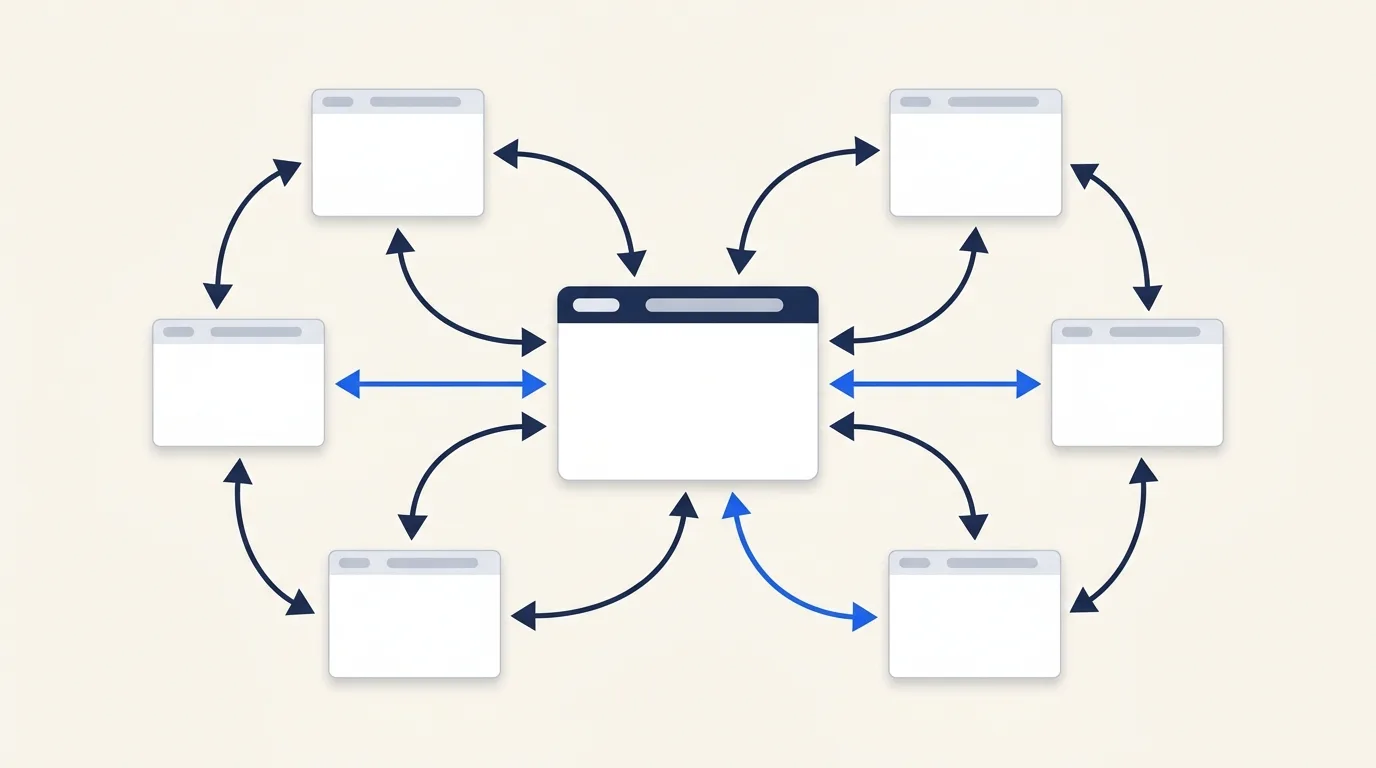
Internal linking is the network of hyperlinks connecting pages within the same website. It's one of the most powerful SEO levers, and one of the most overlooked. In 2026, it serves a dual purpose: distributing PageRank internally and guiding crawlers, whether Googlebot or AI engine bots like GPTBot, ClaudeBot, or PerplexityBot.
Why internal linking is an underrated SEO lever
Internal linking refers to all hyperlinks that point from one page of your site to another page on the same site. This isn't navigation (menu, footer), it's the contextual links inserted into the body of your content.
Its dual role is fundamental:
- PageRank distribution: each internal link transfers a fraction of authority from the source page to the target page. Unlike backlinks, you have complete control over this distribution.
- Crawler guidance: Googlebot follows internal links to discover, recrawl, and re-evaluate your pages. Strong internal linking ensures your important pages are regularly recrawled.
Yet this lever is often neglected in favor of external link building, which is harder to obtain. The irony: internal linking is the only SEO lever you control 100%, with no dependency on third parties.
GEO angle 2026: AI engines (ChatGPT Retrieval, Perplexity, Claude) actively crawl websites via their own bots. GPTBot, ClaudeBot, and PerplexityBot follow internal links to map the hierarchy of your content. Coherent internal linking helps these crawlers identify which pages represent your site's core expertise, and which ones deserve to be cited in their answers.
The two foundations of internal linking
PageRank distribution
PageRank (Google's original algorithm) propagates from page to page through links. Each outgoing link from a page distributes a fraction of its authority among all the pages it links to. This mechanic applies to both external and internal links.
The operational principle: the more internal links a page receives from "strong" pages (pages that are themselves well-linked), the more important Google considers it.
The hub-and-spoke structure leverages this principle: a pillar page (the hub) concentrates links from all satellite pages. In return, the hub transmits its authority to satellites via contextual links. This structure reinforces the thematic authority of the hub, improving its ranking on strategic queries.
Practical example: if you have 20 blog articles covering technical SEO, having 15 of them link to your "SEO Audit" service page significantly strengthens its positioning on commercial queries.
Crawl guidance
Crawl budget is the number of pages Googlebot accepts to crawl on your site per day. On large sites, this budget is limited. On smaller sites, the problem is different: deep pages aren't recrawled frequently enough for Google to detect updates.
The fundamental rule: no important page should be more than 3 clicks from the homepage. High click depth is interpreted by Google as a signal of low importance, the page is buried in the architecture, therefore it doesn't matter.
Good internal linking solves this problem by elevating important pages in the click hierarchy, without necessarily restructuring URLs.
Internal linking architecture: three models
Silo model
The silo model organizes content into separate thematic buckets: each silo corresponds to a theme, and internal links stay within the silo. A technical SEO article only links to other technical SEO articles, never to a content strategy article.
Advantage: strong thematic coherence. Google understands that this silo exclusively covers one subject, reinforcing the authority signal on that theme.
Disadvantage: can create "orphans" between silos and limits global PageRank flow between related themes. In practice, overly rigid organization can isolate content that would benefit from cross-links.
Hub-and-spoke (pillar page + satellite articles)
This is the most effective model for blogs and content sites.
- A long, exhaustive pillar page covers a topic in depth (e.g., "Complete Guide to Technical SEO in 2026")
- Shorter satellite pages cover sub-topics (e.g., "Crawl Budget", "Title Tags", "Internal Linking")
- Each satellite links to the pillar page → the pillar receives authority from all satellites
- The pillar links to each satellite → satellites benefit from the pillar's authority to be discovered
Key advantage: this model creates a virtuous loop. The more satellites you publish, the more authority the pillar gains. The stronger the pillar, the more its links benefit the satellites.
Contextual linking
Contextual linking is the indispensable complement to the two previous models. These are links inserted naturally into the body of the text, with descriptive anchor text, as you write.
The SEO value hierarchy is clear:
- Link in the body text (maximum value)
- Link in the sidebar
- Link in the footer
Navigation links (main menu, footer) carry less value because they appear on every page and are perceived as less contextual. Contextual links, by contrast, signal a direct thematic relationship between the source and target page.
The golden rules of anchor text
Anchor text (the clickable text of the link) is one of the most important signals in an internal link. It tells Google, and AI crawlers, what the target page is about.
What to do:
- Descriptive anchor: the text precisely describes the content of the target page ("our guide on crawl budget", "the content audit method")
- Vary formulations: 3 to 5 descriptive variations toward the same pillar page avoid over-optimization
What to avoid:
- Generic anchors: "click here", "learn more", "see also", no semantic value
- Over-optimized anchors: using the exact same keyword on every internal link to a page signals algorithmic manipulation
- Overly long anchors: anchor text of 8+ words dilutes the signal
Practical rule: vary formulations naturally. "our guide on crawl budget", "crawl budget optimization", and "how to improve your crawl budget" are three valid anchors to the same page, they bring semantic richness without over-optimization.
The GEO angle: AI crawlers and internal linking
In 2026, AI engines are no longer mere consumers of Google's index. ChatGPT, Perplexity, Claude, and Gemini crawl websites directly via their own user agents: GPTBot, PerplexityBot, ClaudeBot, Googlebot-Extended.
These crawlers follow internal links for several reasons:
- Mapping content hierarchy: the most internally-linked pages are identified as the most important on a given topic
- Understanding thematic relationships: link anchors and linked pages signal the semantic structure of the site
- Prioritizing pages to index: like Googlebot, AI bots limit their crawl, good internal linking ensures your key pages are crawled first
Direct implication: pages that receive the most internal links have significantly higher chances of being cited in AI engine answers. This isn't a coincidence, it's the PageRank mechanic applied to LLMs.
Practical tip: create a /resources or /guides page that centralizes links to all your key content. AI crawlers love it because it gives them a complete map of your expertise in a single page.
Common mistakes to avoid
Broken links (404 errors): every link pointing to a 404 page wastes crawl budget and sends a negative signal. Audit your internal links regularly.
Redirect chains: if A redirects to B which redirects to C, go directly to A→C. Each intermediate redirect dilutes the transmitted authority and slows crawling.
Orphan pages: a page with no internal links pointing to it is invisible to Google and AI crawlers. Even if the page exists in your sitemap, it will be crawled less frequently and considered less important.
Image links without sufficient alt text: if your internal link is an image, the alt attribute must precisely describe the target page, it's the equivalent of anchor text for images.
Overloaded navigation menu: a menu with 40 links on every page massively dilutes PageRank. Limit your main navigation to 7-10 links on your most strategic pages.
How to audit your internal linking
With free tools
Google Search Console → "Links" section → "Internal links": you immediately see which pages receive the most and fewest internal links. Strategic pages that appear at the bottom of this list have a linking problem.
Screaming Frog (free up to 500 URLs): the most comprehensive crawler for small and medium sites. It generates a complete internal link map, identifies orphan pages, redirect chains, and broken links.
site: search: in Google, type site:yourdomain.com "keyword of your target page". Results show pages on your site that mention that term, all potential candidates for adding an internal link to your target page.
With seaudit.fr
The seaudit.fr audit analyzes the click depth of all your important pages and identifies those buried too deep in the architecture. It also detects orphan pages and content clusters with poor internal linking.
The report includes an internal linking score /100 with prioritized recommendations: which pages to add links to first, which existing articles to modify, which orphan pages to treat urgently.
Recommendation: rerun an audit after each navigation redesign or after publishing 10+ new pages, internal linking naturally degrades as the site grows.
Action plan: improve your internal linking in 30 days
A concrete 6-step plan, without paid tools:
- Identify your 5 priority pages, the ones you most want to see climb in SERPs (service pages, pillar pages, high commercial-intent pages)
- List all existing articles that could naturally mention these 5 pages, use
site:search to find candidates - Add 1-2 internal links in each identified article, with descriptive and varied anchors toward your 5 priority pages
- Create or identify your pillar page per main topic, if it doesn't exist, now is the time to create it
- Check click depth via GSC or Screaming Frog, no priority page should exceed 3 clicks from the homepage
- Eliminate orphan pages: either by removing them (if they have no value), or by adding links from at least 2 pages on your site
This plan requires no budget, only editorial time. In 30 days, you can significantly improve the ranking of your pillar pages, and increase their probability of citation in AI answers.
Conclusion
Internal linking is one of the few SEO levers you control entirely. It requires no link-building budget, no waiting for external backlinks, no dependency on algorithm updates. In 30 days, with the right priorities, you can significantly improve the ranking of your pillar pages.
In 2026, with the rise of AI crawlers, this lever takes on an additional dimension: strong internal linking doesn't just increase your Google visibility, it also increases your probability of being cited in ChatGPT, Perplexity, and Claude answers.
To automatically audit your internal linking and identify priority fixes, launch the free SeAudit audit. The report analyzes click depth, orphan pages, and gives you an internal linking score /100 with actions ranked by estimated impact.