
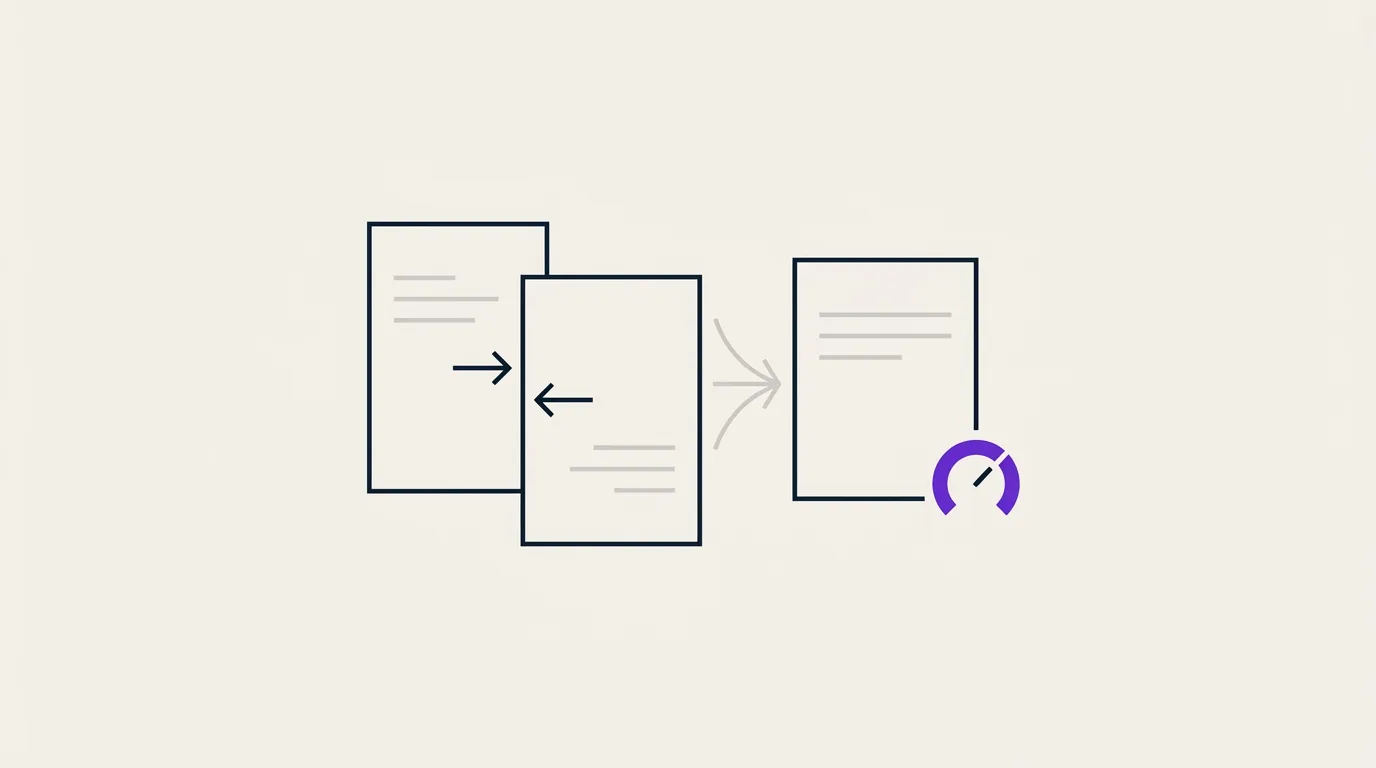
You've got three posts on your blog that basically say the same thing, and none of them cracks position 15. Your first instinct: "I need to rewrite, add more content, retarget the keywords." Wrong diagnosis. The problem isn't that your pages are weak, it's that they're fighting each other. That's keyword cannibalization, and in 2026, with AI engines citing exactly one source per question, it costs you more than it ever did.
What keyword cannibalization actually is (and what it isn't)
Cannibalization happens when two or more pages on your own site target the same query with the same intent. Google has to pick one to show, and it has no reason to consistently favor either, so both stall, when a single consolidated page would have gathered enough signal (links, engagement, authority) to actually break through.
Don't confuse this with a healthy setup: two pages can target similar words with different intent without cannibalizing each other. "Best invoicing software" (comparison) and "how to invoice as a freelancer" (how-to) share vocabulary but answer two distinct needs, no problem letting both exist. The real warning sign is when two pages answer the exact same question, for the exact same person, at the exact same stage of their search.
Why it's an even bigger deal in 2026, thanks to AI engines
On classic Google, cannibalization dilutes your ranking: two mediocre pages instead of one strong one. That's already costly. But AI engines (Google AI Overviews, ChatGPT, Perplexity) make it worse in a specific way: they generally cite exactly one source per question. If they land on two pages from your own site covering the same topic with similar apparent authority, the engine doesn't "split" the citation between them, it picks one arbitrarily, or it drops your domain entirely in favor of a competitor with one clear, complete page on the subject.
In practice: every backlink, every mention, every trust signal you earn gets split between your competing pages instead of stacking on one. A page with 6 quality links almost always beats two pages with 3 links each, whether for Google's ranking algorithm or for the odds of being picked as the source by a generative engine.
How to detect cannibalization on your own site
Three methods, from fastest to most rigorous:
1. Google Search Console, filtered by query. Go to Performance, filter on the query you're worried about, then check the Pages tab: if several of your URLs show comparable impressions with positions that keep swapping week to week, that's the most reliable signal of active cannibalization. Our practical Google Search Console guide walks through reading this report if you're new to the tool.
2. The site: search. Type site:yourdomain.com "your target query" directly into Google. If more than one of your pages shows up for the exact same phrase, you've got your answer in 10 seconds, faster than a GSC export, but less precise, since Google doesn't always surface every competing result.
3. The oscillating-position signal. If you track rankings over time and a given query keeps "switching winning page" from one week to the next with no obvious reason, that's almost always cannibalization: Google is torn between two pages of comparable quality and can't settle the question durably.
Which fix for which case
Not every cannibalization case gets fixed the same way. Here's how to choose:
| Situation | Recommended fix | SEO effect | Effect on AI citation |
|---|---|---|---|
| Two nearly identical pages, same intent | Merge into one page + 301 redirect the other | Consolidates all signal onto one URL | One clear source to cite: strong lift in citation odds |
| Two pages with a slightly different angle that still overlap | Re-split: keep shared sections on a pillar page, specialize the other | Reduces internal competition gradually | Each page becomes identifiable for a specific sub-question |
| An old weak page + a strong recent page on the same topic | 301 redirect the old one to the recent one | Transfers accumulated authority | Removes ambiguity for the AI engine |
| Technical duplicate (URL parameters, HTTP/HTTPS, with/without trailing slash) | Canonical tag to the reference version | Consolidates without deleting content | AI engines generally favor the canonical URL |
Our guide on HTTP redirects covers 301s and when to use them properly if you need to set up several at once.
False fixes to avoid
- Deleting the page without redirecting. You instantly lose every link and signal built up on it, a 301 redirect to the consolidated page costs the same effort and keeps the value.
- Adding a
noindextag without merging the content. You mask the symptom (two pages fighting each other) without fixing the cause (duplicate content adding nothing new): you just lose traffic without gaining authority anywhere else. - Canonicalizing two pages that aren't really duplicates. If both pages genuinely answer different questions, a canonical tag just removes one of them from results for no reason.
- Doing nothing and assuming "it'll sort itself out." Cannibalization never resolves on its own: without intervention (merge, redirect, or re-scoping intent), the two pages keep neutralizing each other, sometimes for years.
A quick numbers-based example
A B2B SaaS client had two articles published three months apart: "best invoicing tool for freelancers" and "freelance invoicing software comparison 2026." Same intent, same audience, roughly 70% content overlap. Before we stepped in, both were stuck between position 14 and 22, with rankings flipping back and forth week to week, a textbook sign of active cannibalization. We merged them into a single, enriched comparison (keeping the older URL, which had more inbound links), 301-redirected the other, and reworked internal linking to point everything at the single page. Six weeks later, the merged page reached position 6, with organic traffic higher than the sum of the two previous pages combined, and it started showing up as a cited source in Google AI Overviews for the query, something neither separate page had ever achieved.
How to prevent cannibalization going forward
The real fix is upstream editorial planning: before publishing a new article, check whether a page already covers the same query with the same intent. Structure your content as a topic cluster, a broader pillar page surrounded by specialized articles on precise sub-questions, instead of isolated articles that overlap. It's the exact same principle that prevents cannibalization upstream instead of fixing it after the fact.
Key takeaways
- Cannibalization means two pages on your own site targeting the same query with the same intent, not just shared vocabulary.
- In 2026 it costs more than before: AI engines generally cite exactly one source per question, and active cannibalization hands that spot to a competitor with a single clear page.
- Detect it via Google Search Console (positions swapping between several of your URLs on the same query) or a targeted
site:search. - The fix depends on the case: merge + 301 redirect for pure duplicates, re-splitting for overlapping-but-distinct angles, canonical tags for technical duplicates.
- Plan your content as a topic cluster to keep the problem from reappearing with every new article.
Want to know if any of your pages are cannibalizing each other right now? Get your score out of 100 in a few minutes, or grab the full PDF report with the detail of competing pages on your own site.
FAQ
Do two pages targeting the same keyword always cannibalize each other? No. If the two pages answer genuinely different search intents (say, a comparison versus a how-to), they can coexist without hurting each other. Cannibalization only shows up when both answer the exact same question for the exact same need.
Should you always merge pages when cannibalization happens? No, merging is the most common fix for pure duplicates, but it's not automatic. If the two pages cover different sub-questions of the same topic, it's often better to re-split them clearly rather than cramming everything into one overly long article.
How long does it take to see the effect of a cannibalization fix? Generally 4 to 8 weeks after a well-executed merge and 301 redirect, while Google and AI engines recompute consolidated authority on the single URL.
Does cannibalization also affect citation by ChatGPT or Perplexity? Yes, often more severely than for Google: these engines pick exactly one source per answer, so two competing pages from your own site reduce your odds of being cited, while a single complete page maximizes that chance.