
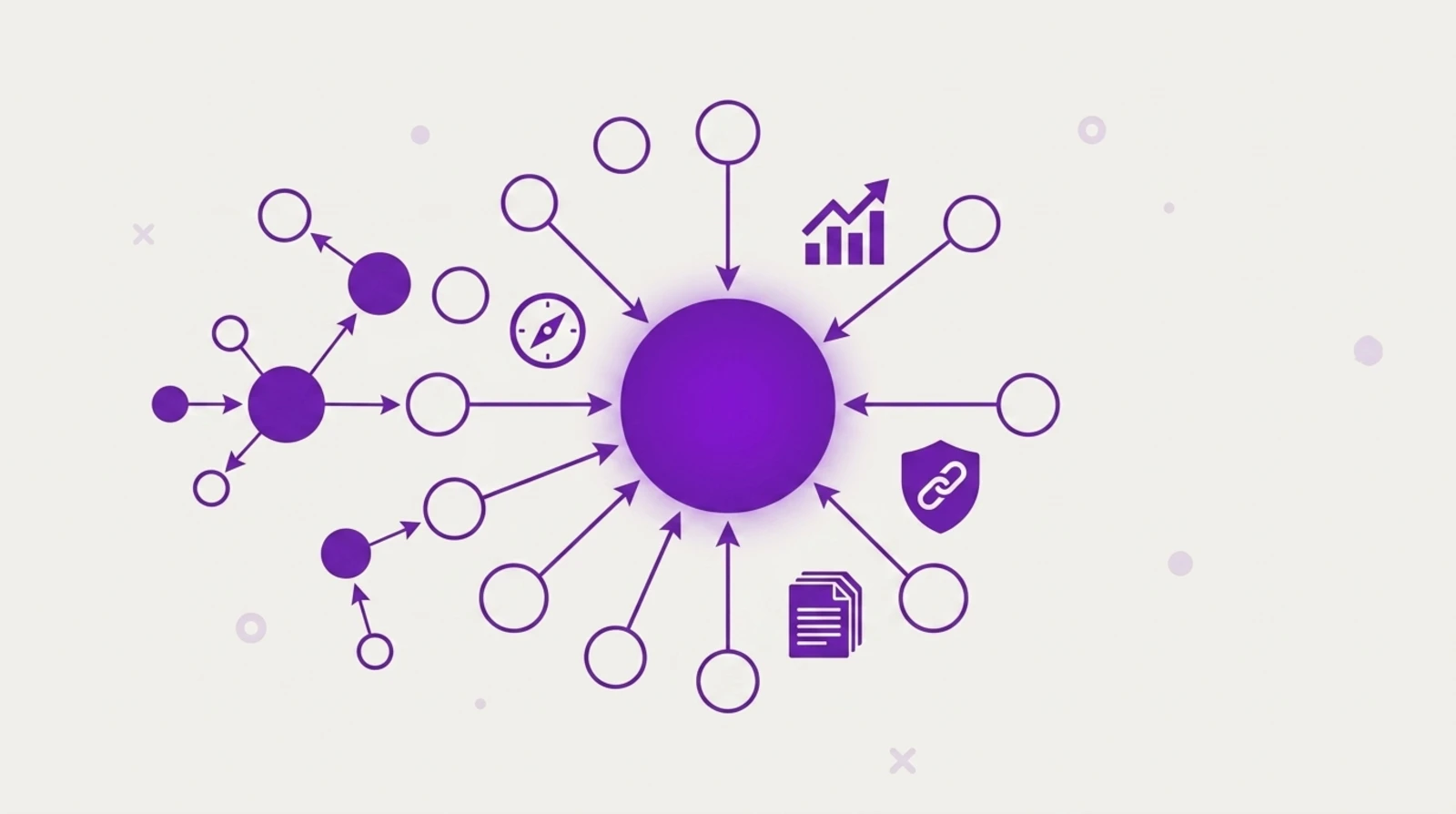
In 2026, backlinks remain one of Google's three most powerful ranking signals, alongside content and user intent. But the game has changed: link volume is no longer what matters, authority and relevance are. And a new dimension has emerged: AI answer engines (Google AI Overviews, ChatGPT Search, Perplexity) also rely on authority signals to decide which sources to cite.
This guide explains what a quality backlink looks like in 2026, why link building impacts both your SEO and your GEO visibility, how to audit your link profile, and which techniques still work, without getting you penalised.
What a backlink is, and why it still matters
A backlink is a hyperlink from another website to yours. Google reads it as a vote of confidence: if a recognised site cites you, your content must be worth referencing. That is the PageRank principle, and despite 25 years of algorithm evolution, it has never gone away.
What has changed is Google's tolerance. In 2026:
- Quantity saves nothing. 10 links from authority sites beat 1,000 links from directories or link farms.
- Topical relevance dominates. A link from a site in your niche carries far more weight than a link from an unrelated general blog.
- Artificial links get caught. Google's SpamBrain system neutralises link schemes instead of merely ignoring them, and can trigger a manual action.
The 4 criteria of a good backlink
Not all links are equal. Here is what to evaluate before chasing (or accepting) a link.
| Criterion | Good signal | Bad signal |
|---|---|---|
| Domain authority | Established site, real organic traffic, clean link profile | New domain, zero traffic, PBN |
| Topical relevance | Site in your niche or an adjacent topic | Unrelated site (casino, sketchy general) |
| Placement | In the editorial body, surrounded by context | Footer, sidebar, partner list |
| Anchor text | Natural, varied, descriptive | Over-optimised, exact-match keyword repeated |
The most underrated detail is contextual placement. A link inserted naturally into a relevant paragraph passes far more value than a footer link, which Google has long discounted.
Dofollow, nofollow, sponsored, ugc
Since 2019, Google treats link attributes as hints rather than strict directives.
- dofollow: standard link, passes authority.
- nofollow: historically "don't follow this link". Now just a hint, Google may still factor it in.
- sponsored: for paid or affiliate links. Use it to stay compliant.
- ugc: for user-generated content (comments, forums).
A 100% dofollow profile is suspicious: it signals artificial acquisition. A natural profile mixes dofollow and nofollow, because real citations come from everywhere (social, press, forums).
Backlinks and GEO: authority weighs on AI too
This is the 2026 shift, and it is still under-exploited. AI answer engines do not "rank" pages the way Google does, they select sources to cite. To assess a source's reliability, they lean on signals that overlap heavily with off-page SEO.
Cited brands are linked brands. LLMs are trained on corpora where the most-cited entities (mentions, links, press) are over-represented. The more your domain is referenced by reliable sources, the more likely it is to surface in a generated answer.
A mention can be worth a link. For GEO, a brand citation in an authority article, even without a clickable link, strengthens your association with a topic in the model's "memory". Modern link building therefore targets the mention as much as the link.
Domain authority filters the noise. Perplexity and ChatGPT Search favour established sources to limit hallucinations. A domain with a solid link profile clears this trust filter; a new, isolated domain gets ignored.
In other words: your SEO link-building work directly feeds your visibility in AI engines. It is the same authority capital.
Techniques that still work (and those to avoid)
| Technique | Type | Risk | 2026 effectiveness |
|---|---|---|---|
| Linkable content (study, data, free tool) | White-hat | None | ⭐⭐⭐⭐⭐ |
| Digital PR / press relations | White-hat | None | ⭐⭐⭐⭐⭐ |
| Quality guest posting (relevant sites) | Light grey | Low | ⭐⭐⭐⭐ |
| Broken link building | White-hat | None | ⭐⭐⭐ |
| Occasional, relevant link exchange | Grey | Medium | ⭐⭐ |
| Bulk link buying / PBN | Black-hat | High | ⭐ (then penalty) |
| Spammed directories and comments | Black-hat | High | ❌ |
The most profitable and durable strategy remains link earning: creating content so useful (an original study, a calculator, a data-backed benchmark) that other sites cite you spontaneously. It is slower than buying links, but it never gets penalised and it compounds over time.
How to audit your link profile
Measure before you build. A backlink audit covers three dimensions.
1. Referring domains. Count the number of unique domains linking to you (more meaningful than raw link count). Look at their authority and topic. A single domain linking you 500 times is worth less than 50 varied domains.
2. Anchor text distribution. Split your anchors into categories: brand ("SeAudit"), bare URL, generic ("click here"), exact-match keyword. A healthy distribution is dominated by brand anchors. An over-representation of exact-match anchors is the number-one signal of a manipulated profile.
3. Toxic links. Identify links from spam sites, link farms, or off-topic domains. They do not help you and, in bulk, can hurt.
Detecting and handling toxic links
A toxic link usually shows several of these signals:
- domain with no real organic traffic;
- topic entirely foreign to yours (or adult / casino content);
- a link profile that is itself spammy;
- an anchor over-optimised on a commercial keyword.
In 2026, Google's doctrine is clear: in most cases, it automatically ignores low-quality links. The disavow file should only be used if you have received a manual action for artificial links, or if you have a black-hat link-building history to clean up. Wrongly disavowing good links can cost you authority, only use this tool deliberately.
A 90-day link-building plan
Days 1-15, Audit. Map your current profile: referring domains, anchor distribution, toxic links. Set your baseline.
Days 16-45, Linkable asset. Produce a resource designed to attract links: an original study with hard data, a free tool, or a reference guide for your niche. This is your link magnet.
Days 46-75, Outreach. Contact relevant sites that could cite your resource: journalists, niche bloggers, pages that list tools. Aim for relationship quality, not email volume.
Days 76-90, Mention and brand. Work on brand citations (digital PR, interviews, expert contributions), the ones that feed your GEO visibility as much as your SEO.
Link building is not a one-off campaign, it is capital you build. In 2026, that capital serves two goals in one: your organic ranking and your presence in AI answers.
Bottom line
Backlinks remain decisive, but quality has definitively replaced quantity. Focus on authoritative, relevant, contextual links earned through genuinely useful content. Monitor your profile, keep a natural anchor distribution, and only disavow when there is a proven problem. And remember: every authority link and mention you earn now strengthens your visibility on both Google and AI engines.