
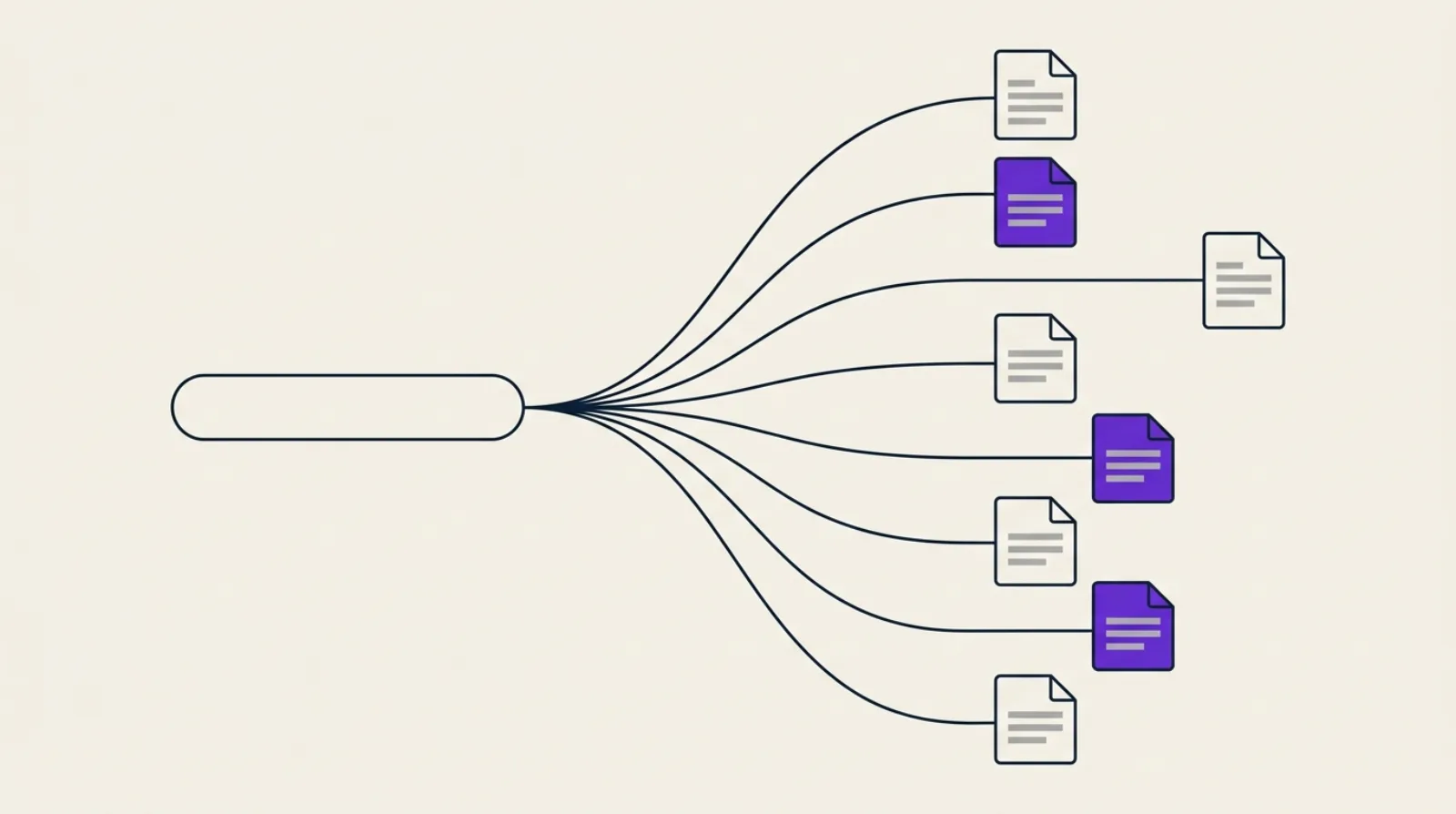
You type a question into AI Mode. Google does not run your sentence as is: it splits it into sub-queries, fires them in parallel, then assembles an answer that cites different pages for each piece. The mechanism is called query fan-out. If your page only answers the main query, it misses most of the searches that are actually executed.
The good news: you cannot read those sub-queries in any official tool, but you can reconstruct them and measure your coverage. Here is the method, with an example taken from our own Search Console data.
What query fan-out actually is
The principle is simple: one query becomes several. Google describes it in its documentation: AI Overviews and AI Mode may use a "query fan-out" technique, meaning they issue multiple related searches across subtopics and data sources, which lets them show a wider and more diverse set of links.
Three factual markers to place the phenomenon:
- Google announced it itself. At Google I/O 2025, the company presented AI Mode as built on this technique, and Deep Search as its extended version: hundreds of searches and a cited report within minutes (source: Google blog).
- A patent describes the principle. Search Engine Journal analyzed a Google patent filed in December 2024, "Thematic Search", which uses the word "themes" for these sub-queries (source: SEJ).
- Google publishes no data. No console shows you the generated sub-queries. Practitioners built simulators, such as Mike King's Qforia (iPullRank), to model the process, but they are approximations.
For the difference between the two interfaces, read our AI Mode vs AI Overviews comparison. Here we focus on what you can do on your side, starting with what the official sources actually say and where they stay silent.
One caution before the method: fan-out explains why long, specific pages get picked up, but it does not guarantee a citation. It raises the number of chances you get, nothing more.
What Google requires (and does not)
The official documentation is clear: to appear in these features, a page must be indexed and eligible to be shown in Search with a snippet. There are no additional technical requirements, and you do not need to create machine-readable files, AI text files or specific markup.
Practical consequence: fan-out is not something you "configure". You win it on substance. Your page must be crawlable and indexed, then answer as many sub-questions as possible, precisely.
Why a "complete" page can still lose
A 3,000-word page that talks about everything is not a page that answers everything. A retrieval system looks, for each sub-query, for a passage it can extract cleanly. Three common ways to lose:
- The answer exists, but is buried in a 200-word context paragraph.
- The sub-question sits under a vague heading ("The stakes"), so it cannot be matched to a question.
- The sub-question is not covered anywhere, because you wrote for the main keyword only.
It is the same reflex as long-tail targeting, detailed in our long-tail keyword strategy guide, but applied inside a single page.
The 5-step method
1. Reconstruct the sub-queries
Start from your target query and collect variants from four free sources:
- Google's "People also ask" block.
- Your query typed into AI Mode: each paragraph of the answer often maps to a sub-question.
- Forums and discussions where your audience asks in its own words.
- Your own Search Console, see the next step.
2. Mine your Search Console
In Search Console, open the Performance report, filter on your page, and look at the query list. To isolate long, conversational queries, add a custom regex query filter:
([^ ]* ){7}[^ ]*
This expression keeps queries of eight words or more. Those are the closest to questions asked to an AI.
3. Build a coverage matrix
A matrix is a table: one row per sub-query, one column for the section of your page that answers it. Here is an illustrative example (sub-queries imagined by us, not from Google) for the query "SEO audit for a SaaS site":
| Sub-query | Section that answers it | Status |
|---|---|---|
| What does a technical SEO audit include? | H2 "The 5 blocks of an audit" | Covered |
| How long does an audit take? | None | Missing |
| Which free tools should I use? | Paragraph in the intro | Buried |
| SEO audit or GEO audit, what is the difference? | Dedicated H2 | Covered |
The "Missing" and "Buried" statuses are your to-do list.
4. Write answer first
For each retained sub-question, a heading phrased like the question or as a clear statement, then the answer in the first two sentences, then the detail. A passage that can be extracted without context is more likely to be reused.
5. Link pages together
If a sub-question deserves 1,000 words, do not cram it into the main page. Write a dedicated page and link to it from the relevant section. That is topical internal linking, covered in our internal linking guide.
A real case: one page, six queries
Here is what our own Search Console shows for seaudit.fr, from September 3 to 30, 2026, for the English version of our article on breadcrumbs and BreadcrumbList markup:
| Query | Impressions | Average position |
|---|---|---|
| breadcrumblist | 2 | 37.5 |
| breadcrumblist seo | 3 | 17 |
| breadcrumbs google seo | 3 | 10.3 |
| breadcrumbs schema | 1 | 18 |
| google seo breadcrumbs | 1 | 9 |
| google search central breadcrumb structured data guidelines | 1 | 10 |
Total: 11 impressions and 0 clicks across six different phrasings, for a single URL. Volumes are tiny, so draw no statistical conclusion. But the pattern is useful: one page is shown on several neighboring phrasings, and its position ranges from 9 to 37 depending on the phrasing.
What it teaches: the phrasings closest to an exact question ("guidelines", "google seo") are where the page ranks best. Bare keywords ("breadcrumblist") are the weakest. It is a hint, not proof, that the page answers worded questions better than isolated words.
Another example from our site: the long query "audit geo avec plan d'action 30 60 90 jours" generated 14 impressions at an average position of 2.7 on our /audit page, with no click over the period. A very specific query, a page that answers it precisely, a high position: exactly the profile fan-out favors. The click is still to be won, because generated answers capture part of the intent.
What not to do
- Invent artificial sub-questions to inflate the number of headings. If nobody asks the question, the section is noise.
- Duplicate the same answer across ten pages. You create cannibalization.
- Promise a measurable gain. Google publishes no fan-out data: you steer with hints (impressions per variant, observed citations), not an official dashboard.
How to check it works
Pick five important pages. For each, note before editing the number of distinct queries that generate impressions (Search Console, page filter, 28 days). Apply the matrix, republish, then compare 28 days later. The right indicator is the number of distinct queries per page, not only clicks. If you want a numbered starting point for your site, get your score /100: the audit flags pages lacking answer-friendly structure.
FAQ
Does query fan-out also exist in ChatGPT and Perplexity?
Google's documentation confirms the technique for AI Overviews and AI Mode. For other engines, internals are not published the same way: treat circulating claims as hypotheses.
Do I need special markup for fan-out?
No. Google states there are no additional technical requirements or specific markup to appear in its AI features. Schema markup remains useful for other reasons, but it is not a condition.
How many sub-queries does an engine generate?
Google does not publish it. Figures you come across (such as "8 to 12") come from agency estimates or simulation tools. Use them as an order of magnitude, not as data.
Do I need one page per sub-query?
No. A section is enough for a short sub-question. A dedicated page is justified when the topic deserves full treatment and can be searched on its own.
How do I know if I am cited in AI Mode?
Query AI Mode with your target queries and note the displayed sources. Search Console also added a dedicated report, covered in our article on the Search Console AI report.
Key takeaways
- Query fan-out turns one query into several parallel searches, according to Google's documentation.
- No extra technical requirement: indexing and snippet eligibility are enough.
- Reconstruct the sub-queries (related questions, AI Mode, forums, Search Console) and build a coverage matrix.
- Write answer first, under a heading that looks like the question.
- Measure the number of distinct queries per page, not only clicks.
Want to see where your pages are structurally weak? Run the free audit and move to the full PDF report if you want the detailed list.