
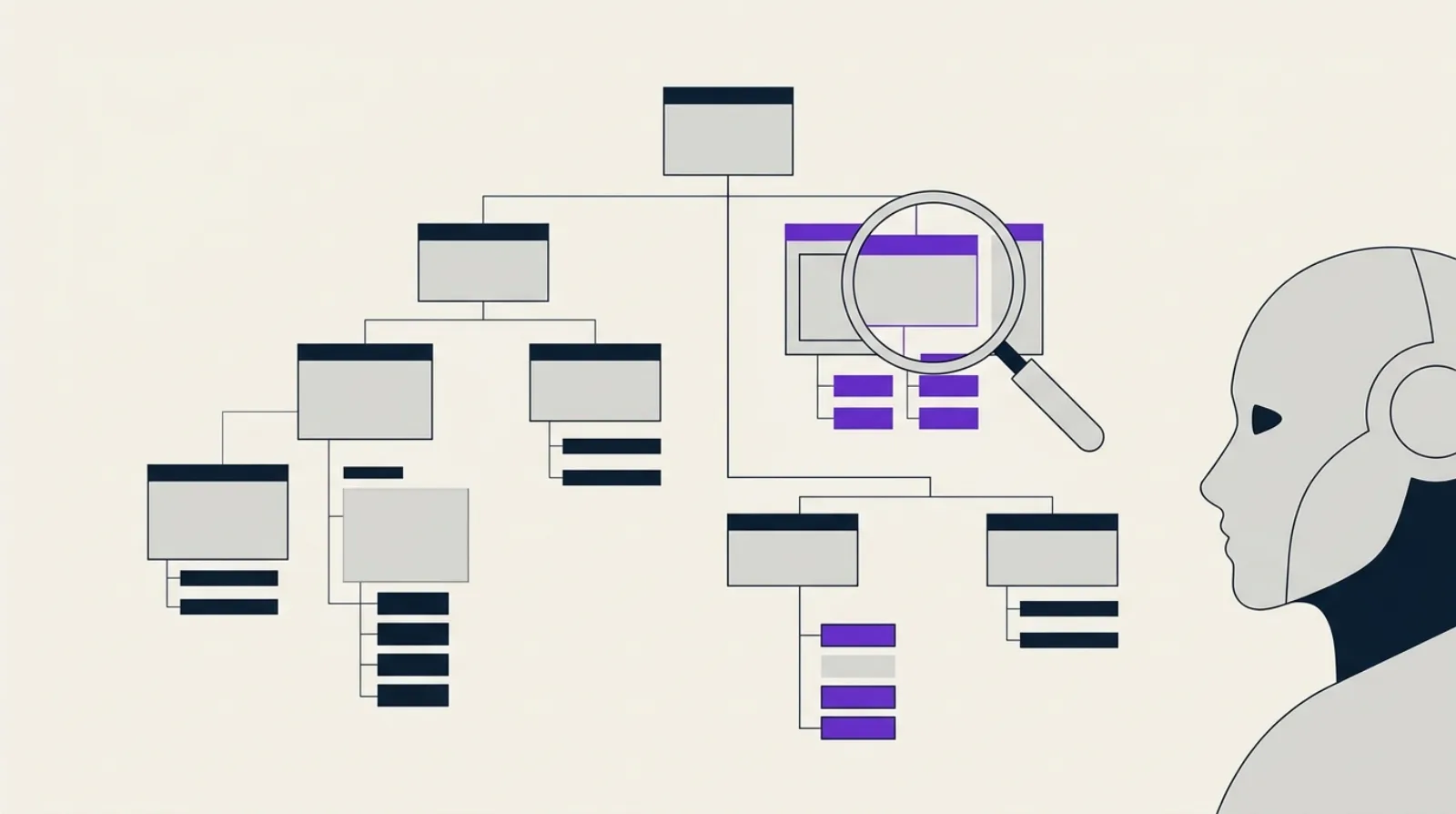
Your Site Architecture Decides Who Finds You, Humans and Bots Alike
You can have the best content on the market, if your pages are buried six clicks from the homepage or linked to nothing at all, neither Google nor AI engines will ever see them. Site architecture, meaning how your pages are organized and linked together, isn't a webdesign detail. It's what tells Googlebot, GPTBot, or ClaudeBot which pages matter, what they're about, and in what order to crawl them.
In 2026, this topic gained an extra layer with the rise of AI answer engines. An architecture built purely for Googlebot can be completely invisible to AI crawlers, which don't work the same way. More on that below.
Click Depth: Is the 3-Click Rule Still True?
Click depth is the number of clicks needed from the homepage to reach a given page. The old 3-click rule remains a useful benchmark: beyond that, crawl frequency drops sharply, and the authority passed through internal linking weakens at every level crossed.
| Depth | Typical crawl frequency | Risk |
|---|---|---|
| 1-2 clicks | High, near-daily on an active site | Low |
| 3 clicks | Adequate | Moderate |
| 4-5 clicks | Low, crawled every few weeks | High |
| 6+ clicks | Rare, sometimes never crawled | Effectively invisible |
This isn't an absolute rule set in stone by Google, it's a mechanical consequence of crawl budget and internal PageRank distribution. The farther a page sits from the homepage, the less signal it receives.
Thematic Silos: Structure Without Isolating
A silo groups pages covering the same theme under a pillar (hub) page, with dense internal links within the silo and sparser links between different silos. The idea: send a strong topical coherence signal, instead of a flat mesh where everything links to everything without hierarchy.
Three traps show up repeatedly in audits:
- The airtight silo: zero links to other silos, artificially isolating complementary content and denying users logical paths.
- The topically inconsistent link: linking an "e-commerce checkout flow" page to a "local SEO" page just because they're on the same site dilutes the relevance signal of both.
- The forgotten sibling link: pages within the same silo rarely link to each other, even though they should be the first to reference one another.
A silo isn't a prison, it's a hierarchy. Pillar pages can, and should, create a few bridges to other silos when the topic genuinely justifies it.
URL Structure: What Actually Matters (and What No Longer Does)
A clean URL reflects the silo's hierarchy and stays readable by a human, not just a machine:
Bad : example.com/index.php?id=482&cat=3&ref=xyz
Good: example.com/shoes/running/nike-pegasus-41
What still matters in 2026: folder depth consistent with the silo, relevant keywords in the slug, no useless indexed parameters. What barely matters anymore: raw URL length (Google has confirmed this repeatedly) and having the exact keyword in the very first position of the slug.
Orphan Pages: The Silent Leak in Your Crawl Budget
An orphan page is one reachable by direct URL or listed in the sitemap, but with no internal link pointing to it. For a crawler that discovers content mainly through links (true for most AI bots, see below), an orphan page is simply invisible.
A 3-step detection method: crawl your site with a tool like Screaming Frog or an open-source equivalent, export the list of URLs discovered through internal links, compare it against the full list from your sitemap.xml and your database. Any URL present in the sitemap but absent from the link crawl is orphaned. Realistic target: zero orphan pages, and a minimum of two to three inbound internal links for every page with real SEO value.
Internal Linking: Parent/Child, Anchors, and the "Click Here" Mistake
Internal linking distributes authority and clarifies hierarchy. Two simple rules fix 80% of the issues we see in audits:
- Descriptive anchors over generic ones. A "click here" link tells a crawler nothing about the target page's content. An anchor like "internal linking strategy" carries a real topical signal.
- Every child page should link back to its parent, and vice versa. The downward link (parent to child) builds the hierarchy, the upward link (child to parent, often via breadcrumbs) confirms it and helps users orient themselves.
The GEO-Specific Angle: Does Your Architecture Even Exist for AI Crawlers?
This is the part most SEO architecture guides skip entirely. GPTBot, ClaudeBot, and PerplexityBot don't execute JavaScript. They fetch the raw HTML returned by the server, extract whatever they find, and move on, no waiting for client-side rendering, no second attempt.
In practice: if your navigation menu, "load more" links, or cross-silo internal linking are injected via JavaScript after the initial page load, they simply aren't in the HTML these AI crawlers receive. Your silo architecture, however clean it looks visually and to Googlebot (which does execute JavaScript through deferred rendering), can be entirely invisible to the engines powering ChatGPT, Claude, or Perplexity.
The check is simple: disable JavaScript in your browser (or use "View Page Source" rather than the inspector), and see whether your strategic internal links are still there. If a link only exists in the DOM generated after React or Vue hydration, it doesn't exist for these bots. We cover the full technical implications of JS rendering in our SSR/SSG/CSR guide.
A Numbers-Based Example: Silo Restructuring on a B2B SaaS Site
An example we handled in audit: a B2B SaaS with 240 pages (product, blog, documentation), organized in a flat mesh with no clear hierarchy. The crawl revealed 38 orphan pages, mostly old blog posts never linked from newer content, and an average depth of 5.1 clicks across the whole site.
After restructuring into four thematic silos (product, use cases, technical resources, blog), systematically reattaching orphan pages to their relevant silo, and switching the navigation from JavaScript-rendered to server-rendered: average depth dropped from 5.1 to 2.6 clicks, the share of pages actually indexed rose from 61% to 89% in just under two months, and the number of pages cited as source fragments by AI engines (measured through server logs and bot user-agents) multiplied by 2.3 over the same period.
FAQ, SEO and GEO Site Architecture
How many thematic silos should I create?
There's no magic number. Count roughly one silo per major topic or product family you offer, with a clear pillar page per silo. A site with 5 to 10 silos is common for a mid-size SaaS or e-commerce store, more if the catalog is large.
Should I rebuild the whole architecture at once during a migration?
No, that's risky. Prioritize high-traffic or high-potential pages, restructure silo by silo, and monitor the impact on crawling and indexing before moving to the next one.
Are breadcrumbs enough to avoid orphan pages?
No. Breadcrumbs help users and bots climb back to the parent page, but they don't create an inbound link to child pages from other content in the same silo. You need both.
Key Takeaways
A solid site architecture rests on three pillars: controlled click depth, coherent-but-not-isolated thematic silos, and zero orphan pages. In 2026, add a fourth check: verify that your internal linking actually exists in the raw HTML, not only after JavaScript executes, otherwise your architecture stays invisible to the AI crawlers powering ChatGPT, Claude, and Perplexity.
Want to know if your site has orphan pages or a click depth that's dragging down your crawl? Run a SeAudit audit and get your score out of 100, with a sample full report if you want to see the level of detail before diving in.