
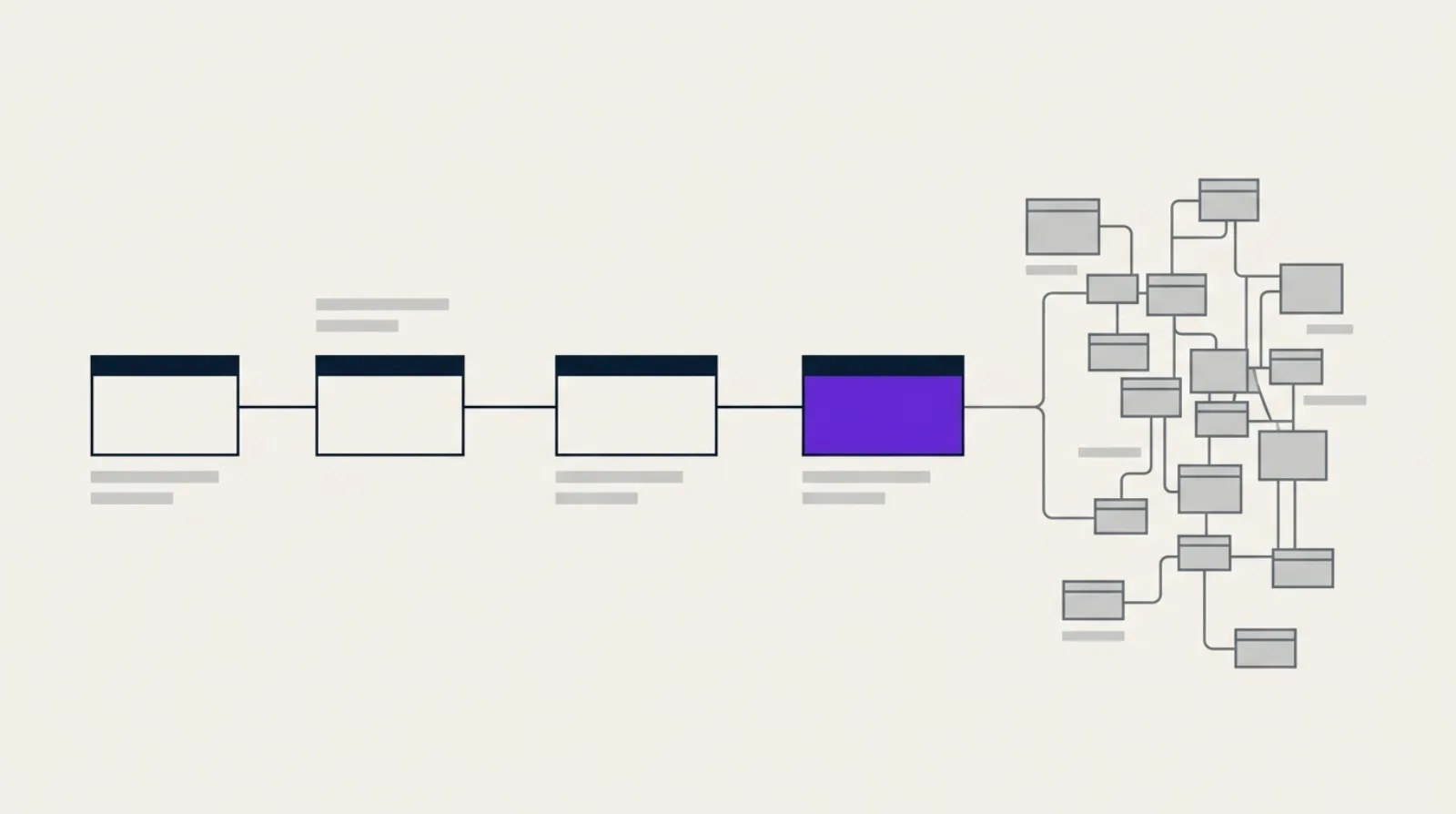
Your URL /product.php?id=4821&cat=12&ref=newsletter isn't just ugly. It burns crawl budget, dilutes your internal linking, and now that Perplexity and ChatGPT Search display the domain (and sometimes the full path) right under their answers, it also damages the trust a user places in your brand before they've even clicked.
URL structure is one of the oldest SEO topics, and yet one of the most poorly applied in 2026. This guide covers the rules that actually matter (the ones Google has repeated for fifteen years), adds what changed with the rise of AI answer engines, and ends with a concrete rebuild example.
Anatomy of a Clean URL
A URL breaks down into four blocks: the protocol (https://), the domain (yoursite.com), the path (/category/subcategory/) and the final slug (/page-name). Everything after a question mark is a parameter, useful for tracking, dangerous for crawling when left unmanaged.
Compare these two URLs pointing to the same product page:
- Clean: yoursite.com/running-shoes/nike-pegasus-41
- Messy: yoursite.com/index.php?p=product&id=4821&cat=12&session=a83f92&ref=newsletter
The first tells Google, and any human reading it in the results, exactly what the page is about before they've even clicked. The second tells Googlebot, GPTBot, and the user nothing at all.
The Rules That Never Change
Lowercase, Hyphens, One Keyword
Use hyphens to separate words, Google treats them as word separators, unlike underscores which are read as a single block. Stay lowercase everywhere: /Running-Shoes/ and /running-shoes/ are two different URLs to a case-sensitive server, meaning two potential sources of duplicate content. Include your target keyword once in the slug, repeating it three times reinforces nothing and reads as stuffing to Google.
Logical Depth, Not a Maze
Aim for 3 to 4 levels maximum between your homepage and your deepest page. /blog/technical-seo/url-structure/ is still readable. /category/subcategory/sub-subcategory/filter/product/variant/ is not, neither for a visitor nor for a crawler that has to follow six links to reach the page.
Subfolders Over Subdomains
A blog hosted at blog.yoursite.com is treated by Google as a potentially distinct entity from yoursite.com. yoursite.com/blog/ consolidates authority in one place. Unless you have a real technical constraint (multi-tenant setup, mandated infrastructure separation), always favor the subfolder.
Stability: Never Change a URL Without a Redirect
Every indexed URL that changes without a redirect loses its accumulated link history and trust. If you need to rename a page, redirect the old URL to the new one immediately, with a 301, and avoid chains (A to B to C) that dilute link equity at every hop. If you're planning a larger rebuild, our complete site migration guide walks through the redirect plan you need before touching a single URL.
URL Length: Myth or Real Factor?
Google has confirmed it several times: URL length is not a direct ranking factor. But market observations converge on a pattern: among first-page results, the average URL runs around 60 to 70 characters, and technical guides recommend staying under 75 characters for readability. This isn't a Google rule, it's a consequence: a short URL is almost always the sign of a well-structured one, with a targeted slug rather than a stack of subcategories.
In practice, think in words rather than characters: 3 to 5 meaningful words in the slug, skipping filler words (the, of, for) unless they change the meaning.
Parameters, Tracking, and Faceted Navigation: the Real Hidden Danger
The real SEO risk doesn't come from a slightly long URL, it comes from unmanaged parameters. An e-commerce site with 10 possible filters and 3 values each can generate over 1,000 URL combinations for 50 actual products, exactly the kind of waste that drains your crawl budget.
Three levers to handle this cleanly:
- Consolidate every filtered variant toward the clean category URL with a canonical tag
- Block non-essential parameters in your robots.txt file
- Keep tracking parameters (UTM, ref) out of the canonical URL and out of the sitemap
If you're running a catalog with lots of filters, the topic deserves its own deep dive, which is exactly what our faceted navigation guide for e-commerce covers.
The GEO Angle: Your URL Is Now a Visible Trust Signal
Until recently, your URL was mostly a technical detail hidden under the blue title of a Google result. That's no longer entirely true. When Perplexity, ChatGPT Search, or Google's AI Mode cite a source, they often display the domain, and sometimes the full path, in plain text right in the answer, not just a discreet link at the bottom. A URL like yoursite.com/seo-audit-guide-2026 inspires instant trust. A URL like yoursite.com/index.php?p=8291&preview=true discourages a click, even when the content behind it is excellent.
There's also a difference in technical tolerance between crawlers. Googlebot, after more than twenty years of experience, generally knows how to deduplicate parameterized URLs intelligently. AI crawlers (GPTBot, PerplexityBot, Anthropic's bots) are younger, crawl less frequently and less deeply, and don't always get the chance to come back multiple times to figure out that a parameterized URL and its clean version point to the same content. A confusing URL architecture is therefore more likely to cost you an AI citation than a Google ranking.
Concrete Example: What a Typical URL Rebuild Shows
Here's a representative case of what a SeAudit audit typically reveals on a mid-sized e-commerce or SaaS site:
| Before | After |
|---|---|
| /index.php?p=product&id=4821&cat=12 | /running-shoes/nike-pegasus-41 |
| /blog/index.php?post=93&lang=en | /blog/url-structure-seo-geo-guide-2026 |
| /category.php?cat=running&sub=men&filter=size-9 | /running-shoes/men |
On this kind of rebuild, the observed patterns tend to point to the same conclusions: the number of indexable URLs drops sharply (fewer duplicates generated by parameters), organic click-through rate improves slightly (a readable URL builds trust in the results), and crawling finally concentrates on the pages that matter instead of thousands of filter variants. It's not magic, it's the direct consequence of less crawl budget waste and clearer signals sent to both Google and AI engines.
Key Takeaways
- Lowercase, hyphens, one unique keyword, a maximum depth of 3 to 4 levels
- Character length isn't a direct ranking factor, but a short URL is often the symptom of a well-structured one
- The real danger is unmanaged parameters that multiply URLs and drain your crawl budget
- A clean, readable URL is also a trust signal displayed in plain text by AI answer engines
- Never change an indexed URL without redirecting it immediately to the new version
Want to know if your URL structure is dragging down your crawl and your AI visibility? Get your free /100 score, the SeAudit report automatically flags the parameters wasting your crawl budget and the redirect chains to fix first.
FAQ
Should I rebuild all my URLs if they don't follow these rules?
Not urgently. If your current URLs are indexed and driving traffic, a rushed rebuild without proper redirects does more harm than good. Prioritize applying these rules to new pages, and only touch existing URLs during a larger rebuild, with a complete redirect plan.
Are URL parameters (UTM, tracking) bad for SEO?
Not inherently, they're even necessary for marketing tracking. The problem appears when a parameterized page has no clear canonical tag pointing to its clean version, or when those variants end up in the sitemap. Keep tracking parameters out of the canonical version and out of the sitemap.
Does www vs non-www still matter for SEO?
No, it's no longer a ranking factor in 2026. What matters is consistency: pick one version, with or without www, and consistently redirect the other to it, so Google doesn't treat them as two separate sites.
How long does it take Google to pick up a new URL structure?
It depends on site size and crawl budget, but expect several weeks for a mid-sized site, the time it takes Googlebot to recrawl all the old URLs, discover the redirects, and transfer signals to the new pages. An up-to-date sitemap and a Search Console submission speed up the process.