
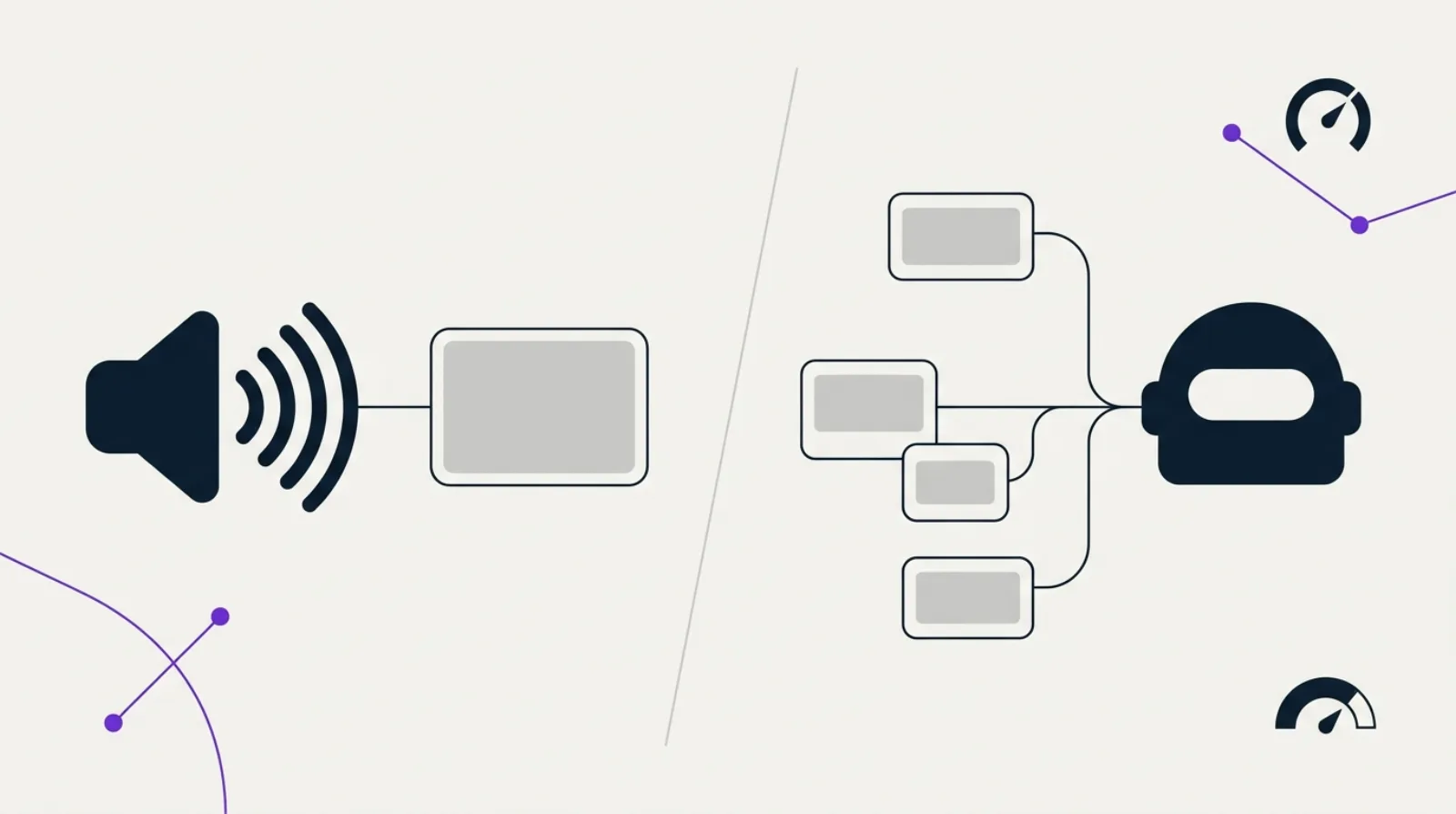
Voice Search and Conversational AI: Two Channels People Keep Mixing Up
Search "voice search SEO" in 2026 and you'll find guides that lump Google Assistant, Siri, Alexa, ChatGPT, and AI Overviews together under one vague "AI assistants" label. The problem: these are two technology families with completely different retrieval mechanics. Optimizing for one barely moves the needle for the other.
That confusion wastes real SEO time. Teams ship Speakable markup, rework their Google Business Profile, trim every answer down to 40 words... then wonder why ChatGPT never cites them. Makes sense — it's not the same game.
This guide separates the two channels, backed by a hands-on test.
Channel 1: Classic Voice Search (Siri, Google Assistant, Alexa)
Technically, voice search through an assistant like Google Assistant isn't an independent engine. It's an interface that queries the regular Google index. The flow is four steps:
- Your voice gets transcribed into a text query.
- Google runs that query against its standard index — the same one that powers regular web search.
- The assistant reads out the single most likely answer: a featured snippet (position zero), a Knowledge Graph answer, or a Google Business Profile listing for local queries.
- One answer only. No alternate sources, no clickable link.
Optimizing for classic voice search is standard SEO with three priorities dialed up: featured snippets, structured data (FAQPage, HowTo, LocalBusiness), and mobile speed. Siri leans heavily on similar mechanics through Bing and Apple Maps for local. Alexa works a bit differently (results often pulled from partner sources or Bing), but the logic holds: a single answer, sourced from a traditional search index.
Channel 2: Conversational AI Engines (ChatGPT, Perplexity, Claude, AI Overviews)
Conversational AI engines run on a different architecture: RAG (retrieval-augmented generation). The flow looks like this:
- The user asks a question in natural language, sometimes complex or multi-turn.
- The engine queries its own index — fed by dedicated crawlers like GPTBot, PerplexityBot, or ClaudeBot — or runs a live web search.
- It selects several sources, extracts the relevant passages, and generates a synthesized answer citing anywhere from 3 to 8 different sources.
- The user sees the sources, can click through, and compare viewpoints.
The key difference: where classic voice search gives you ONE answer with no link, conversational engines cite SEVERAL sources with visible links. What matters here: a clear semantic structure, solid perceived authority (E-E-A-T), open access for AI crawlers (see our robots.txt guide for GPTBot and ClaudeBot), and above all, content written to be extractable — self-contained paragraphs, clear numbers, direct answers in one to three sentences.
Technical Comparison
| Classic Voice Search | Conversational AI Engines | |
|---|---|---|
| Examples | Google Assistant, Siri, Alexa | ChatGPT, Perplexity, Claude, AI Overviews |
| Answer source | Standard Google/Bing index | Dedicated crawl (GPTBot, PerplexityBot, ClaudeBot) + live web search |
| Number of answers | 1, read aloud | 3 to 8 cited, browsable sources |
| Visible clickable link | No | Usually yes |
| Main lever | Featured snippet, Knowledge Graph, local listing | Semantic structure, source authority, crawl access |
| Key structured data | FAQPage, HowTo, LocalBusiness, Speakable | Article, Organization, FAQPage (indirect extraction) |
| Measuring success | Nearly impossible to track (no click) | Trackable via server logs and brand mentions |
A Quick Test: Same Question, Two Channels, Two Outcomes
Test run on a simple query: "what's the best free tool to audit my site's SEO."
- On Google Assistant: the spoken answer reads back a single featured snippet, with no clickable link and not always a named tool. The user has to unlock their phone and search manually to go further. One shot, one winner.
- On Perplexity: the answer lists 3 to 4 tools with a short comparison, each backed by a citable, clickable source. The user can verify, compare, and click straight through to several sites.
The practical takeaway for an SEO/GEO team: voice search stays a binary position-zero fight — you either have the answer or you don't exist — while conversational GEO is a fight for presence among several sources cited side by side. Different KPIs, different deliverables.
The Costly Mistake: Treating Both as the Same Project
The classic 2026 trap: a team spends three weeks shipping Speakable markup, rewriting content into 40-word answers for "the voice assistant," then sees zero change in ChatGPT or Perplexity citations. Makes sense — Speakable was built for Google Assistant's text-to-speech pipeline, not for LLM extraction. Conversational engines don't rely on it to pick their citations; they parse the raw text, its structure, its authority signals.
The reverse is also true: a GEO strategy built for ChatGPT and Perplexity (extractable content, cited sources, brand mentions) won't mechanically boost your classic voice search presence, which stays tightly correlated to your traditional Google SEO ranking.
Both projects share a common foundation — clear, structured, authoritative content — but distinct optimizations downstream. Confusing the two means spending SEO budget on the wrong lever.
Action Checklist, Channel by Channel
For classic voice search (Siri, Google Assistant, Alexa):
- Target the featured snippet on your priority informational queries — a 40-to-50-word answer placed near the top of a section.
- Structure content as Q&A with FAQPage and HowTo markup where relevant.
- Optimize your Google Business Profile if you have a local component: hours, reviews, up-to-date address.
- Check your mobile speed — a low mobile PageSpeed score directly hurts featured-snippet eligibility.
For conversational GEO (ChatGPT, Perplexity, Claude, AI Overviews):
- Explicitly allow AI crawlers in your robots.txt if you want to get cited: check GPTBot, PerplexityBot, ClaudeBot.
- Write self-contained paragraphs — one idea, one number, one source per block, extractable out of context.
- Build authority signals: unlinked mentions, third-party citations, an identified author. LLMs weigh perceived source credibility.
- Track citations you actually earn through server logs or a GEO tracking tool, rather than indirect proxies.
Want to know where you stand on both fronts instead of guessing? Run a free audit at /audit: you'll get a score out of 100 covering both your classic SEO visibility and your citability by AI engines. You can also check a sample detailed report before diving in, or grab the full PDF report with a prioritized action plan for each channel.
Key Takeaways
- Classic voice search (Siri, Google Assistant, Alexa) relies on the Google/Bing index and gives ONE answer with no clickable link.
- Conversational AI engines (ChatGPT, Perplexity, Claude, AI Overviews) use RAG, dedicated crawlers, and cite SEVERAL clickable sources.
- Speakable markup serves classic voice search, not GEO — don't confuse the two investments.
- Both projects share a common foundation but have distinct downstream levers.
- Measure separately: featured-snippet position for classic voice, real citations (logs, mentions) for GEO.
FAQ
Does Speakable markup improve my visibility in ChatGPT? No. Speakable is built for Google Assistant's text-to-speech pipeline, not for LLM extraction. Conversational engines parse raw text and its semantic structure, not this specific markup.
Should I prioritize classic voice or conversational GEO in 2026? Depends on your audience. B2C with a strong local or mobile component: prioritize classic voice (featured snippets, local listing). B2B or sectors with heavy informational search: prioritize conversational GEO, where usage is growing fastest right now.
How do I know if I'm being cited by ChatGPT or Perplexity? Check your server logs for GPTBot, PerplexityBot, and ClaudeBot crawls, and manually monitor (or use a GEO tracking tool) your industry's strategic queries to see if your site shows up as a cited source.
Is voice search declining in 2026? Usage stays stable to significant on mobile, especially for local and simple transactional queries. What's shifting is the share of attention moving toward conversational AI engines for complex or comparative queries — two usages that coexist rather than fully replace each other.